How to meet an Australian Shepherd's need without building a dog who only gets more intense, and without spending your weekends running.
His energy is not a flaw to fix. It is a need to balance across exploration, learning, movement and recovery, with a pause button that can be taught.
Keep reading if you want to:
- Understand what belongs to the breed and what belongs to your own dog.
- Balance 4 distinct needs, instead of endlessly increasing the one you can see.
- Teach the pause button, meaning the ability to come back down on cue.
- Channel chasing and herding, the behaviours that surface on their own in this breed.
- Pick activities that help at home, not just longer and longer walks.
- Spot the mistakes that mechanically build a more intense dog every week.
From: Léa Fontaine
The Pup Method, a step-by-step training approach built on observation, repetition and positive reinforcement.
Dear human of a dog who anticipates everything,
He follows you from room to room. He stares at the door, the bike, the kids' ball. You have done 2 hours of walking and he still looks at you like the day is only starting.
Faced with that, the advice goes in circles:
- “He is a herding dog, he needs sport.” Sport builds fitness. A better conditioned dog needs more effort to feel the same tiredness: the bar goes up instead of down.
- “Put him in agility, he will burn it off.” A structured activity is useful. Used as an outlet, it mostly adds arousal to a dog who already produces plenty.
- “He is bored, keep him busy all the time.” A dog kept busy nonstop never learns to do nothing. And that is exactly the skill that is missing most often.
So the weekend turns into a race, the week into guilt, and your dog's intensity keeps climbing quietly.
If that sounds like you, remember this:
The dog who never stopped, and what I had misunderstood
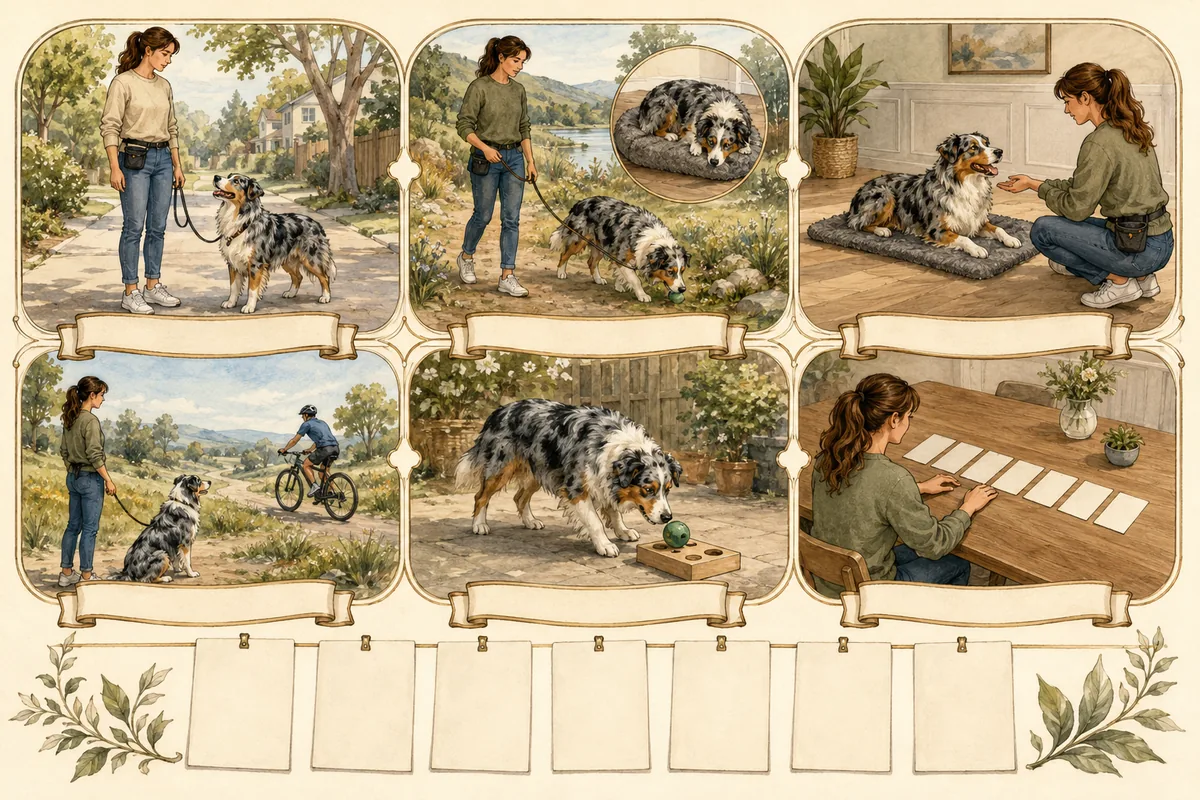
The balance map: the 4 needs, and what happens when only one is fed.
My first Australian Shepherd followed me from room to room, stared at the door, anticipated every move. I was doing 3 hours of activity a day. I was exhausted, he was not.
I ended up keeping a journal for 2 weeks: what he did, what I offered, and above all how long he took to settle afterward.
The result left no doubt. After a ball session, he took 50 minutes to come back down. After 10 minutes of a sniffing game, he was asleep in 5 minutes.
I was feeding only one of his needs, the most visible one, and training him to want more and more of it.
Calm did not arrive by tiring him out further. It arrived by balancing, and by teaching him explicitly to stop.
The problem is not the breed, it is the balance
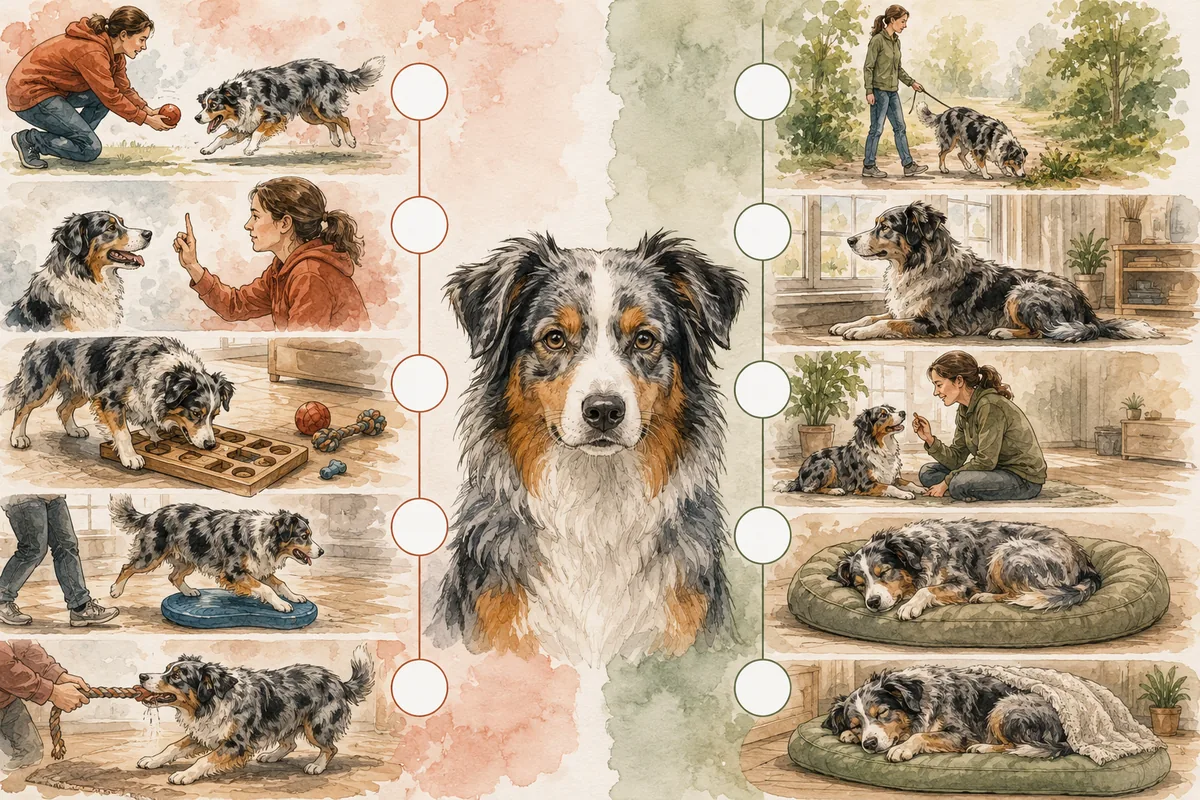
Activity versus availability: why doing more does not create calm.
This breed was selected to work for long stretches, anticipate movement and stay alert. Those qualities do not disappear because the dog lives in a city.
When a single need is fed, running, the others stay on hold and come out elsewhere: chasing bikes, herding the kids, reacting to the smallest movement.
So the work is to spread things out: exploration, learning, movement, and above all recovery, the need that gets forgotten most often.
A dog who cannot come back down ends up needing more and more activity to reach the same calm. That is the loop you have to break.
At this point, you have 2 options
The second option takes less daily time than the first. What it asks instead is that you accept that calm is taught, rather than hoping it shows up through exhaustion.
The 4 needs and the pause button
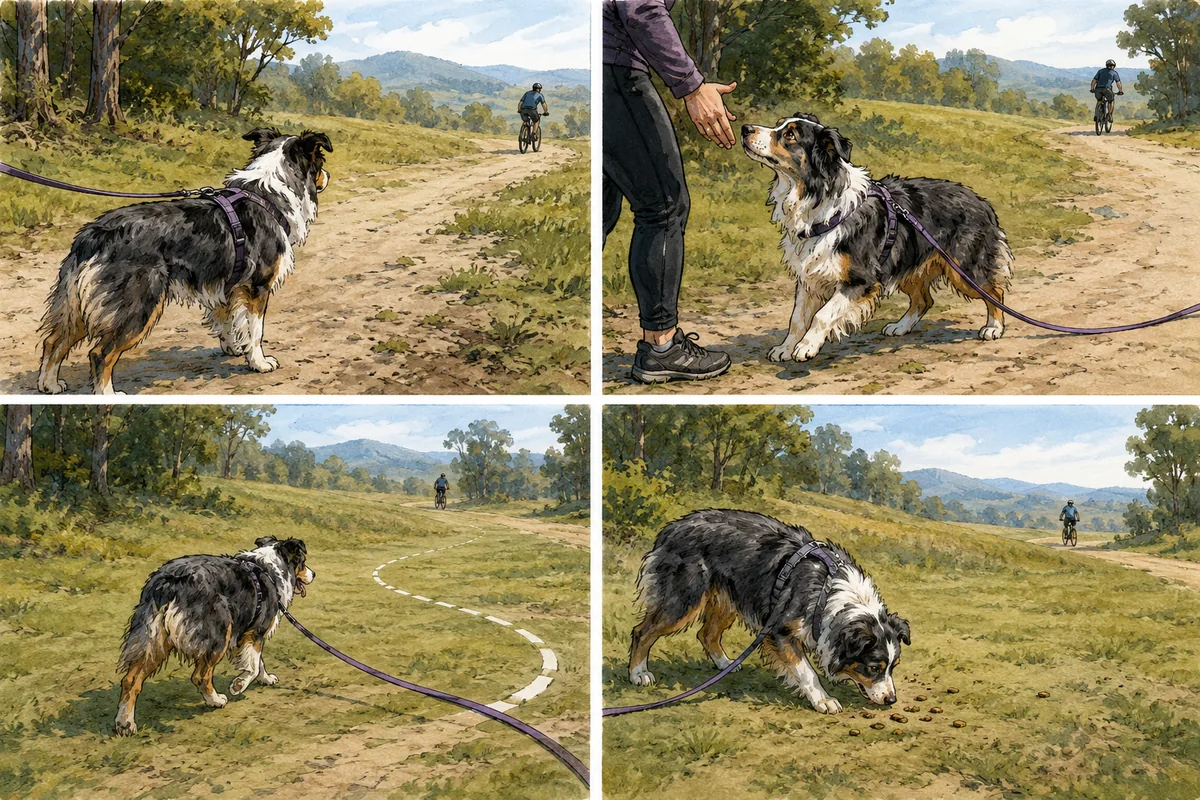
The alternative to chasing, given before he takes it himself.
The book builds a balance, then adds the skill that is almost always missing.
- Know the breed without boxing in the individual. What comes from selection, and what comes from your own dog.
- Balance 4 needs. Exploration, learning, movement, recovery: none of them replaces the others.
- Teach the pause button. The ability to come back down on cue, trained like any other exercise.
- Channel chasing and herding. Give an acceptable outlet to behaviours that will surface anyway.
- Pick the right activities. What helps at home, what helps outside, and what only adds intensity.
- Spot the mistakes that amplify. The daily habits that build a more intense dog without anyone noticing.
A 4-week plan and a troubleshooting set of twelve common situations close the book.
Just imagine for a moment...
- Watching your dog settle and let out a sigh after an activity, instead of looping straight back.
- Having a signal that brings him back down, at home and outside.
- Spreading 20 minutes well chosen through the day rather than 2 hours in one block.
- Getting through a rainy day without the house paying for it.
- Watching bike chasing become manageable because it has an alternative.
“Will this work for me?”
He is a working dog, he needs sport. He needs activity, not only sport. The book separates 4 needs, and shows what happens when a single one is fed.
I have no livestock and no big yard. Not one activity in the book asks for that. Everything happens at home, in town, or on an ordinary walk.
He is 5 years old, is it too late to calm him down? No. The pause button can be taught at any age, and often faster with an adult dog who has already learned how to learn.
Does this hold for a Border Collie? The part on the 4 needs and the pause button applies to every herding dog. Only the activities change at the margins.
The good news: calm is taught like everything else
The ability to come back down is not a personality trait. It is an exercise, with a protocol, a progression and criteria, exactly like a sit or a recall.
- You do not need livestock or a big yard.
- You do not need to compete in dog sport.
- You do not need to keep him busy all day long.
What you need is to spread the right kinds of activity and to train the pause explicitly.
I am glad to introduce the digital book:

Channel Your Australian Shepherd's Energy, Every Day: meet your dog's need for activity without feeding constant restlessness.
This book is a balance manual. It explains what each kind of activity produces, how to teach the stop, and which daily habits keep the intensity going without being noticed.
It is organised in 7 parts, with a 4-week plan, twelve troubleshooting situations and practical worksheets. This is a digital book to download, not a paper book shipped to your door.
Here is a preview of what you are going to learn
6 blocks that connect understanding, protocol and transfer into real life.
Part 1: know the breed without boxing in the individual
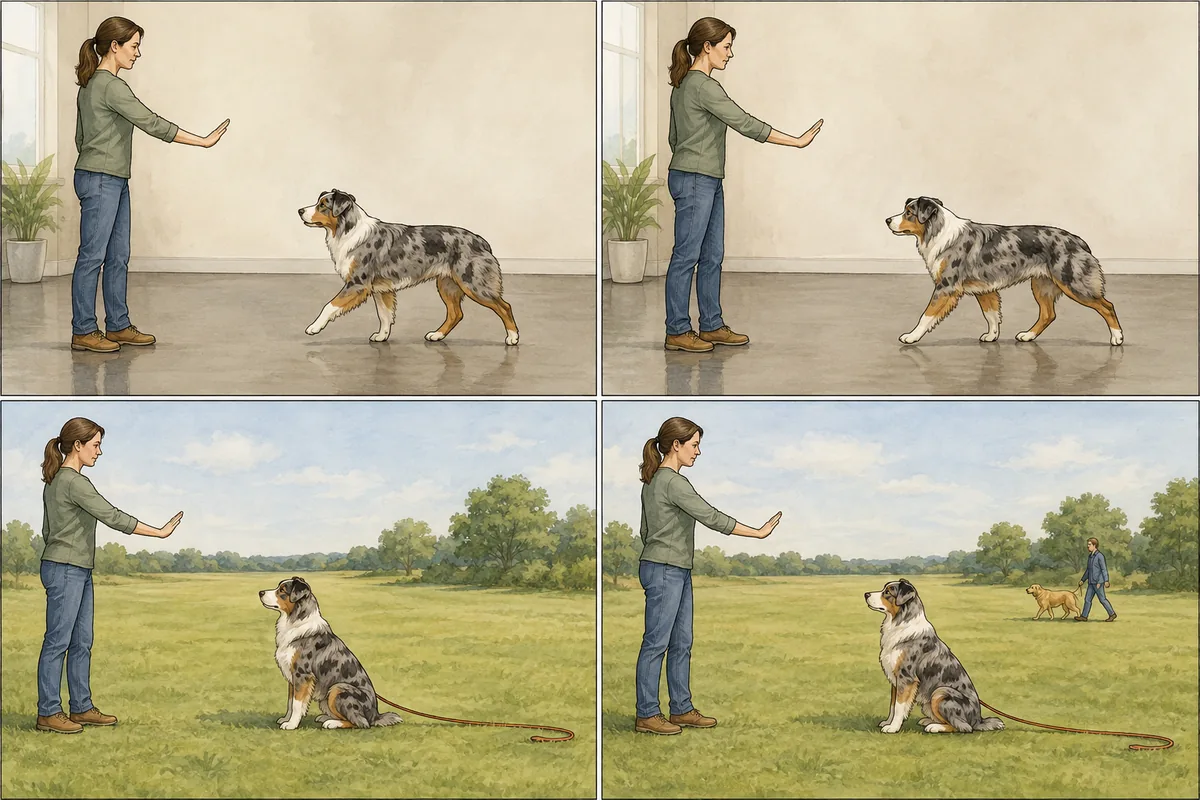
What comes from selection, what comes from your dog.
- The real tendencies of the breed
- Why 2 Australian Shepherds are never alike
- Watching your dog rather than a breed profile
Part 2: 4 needs to balance
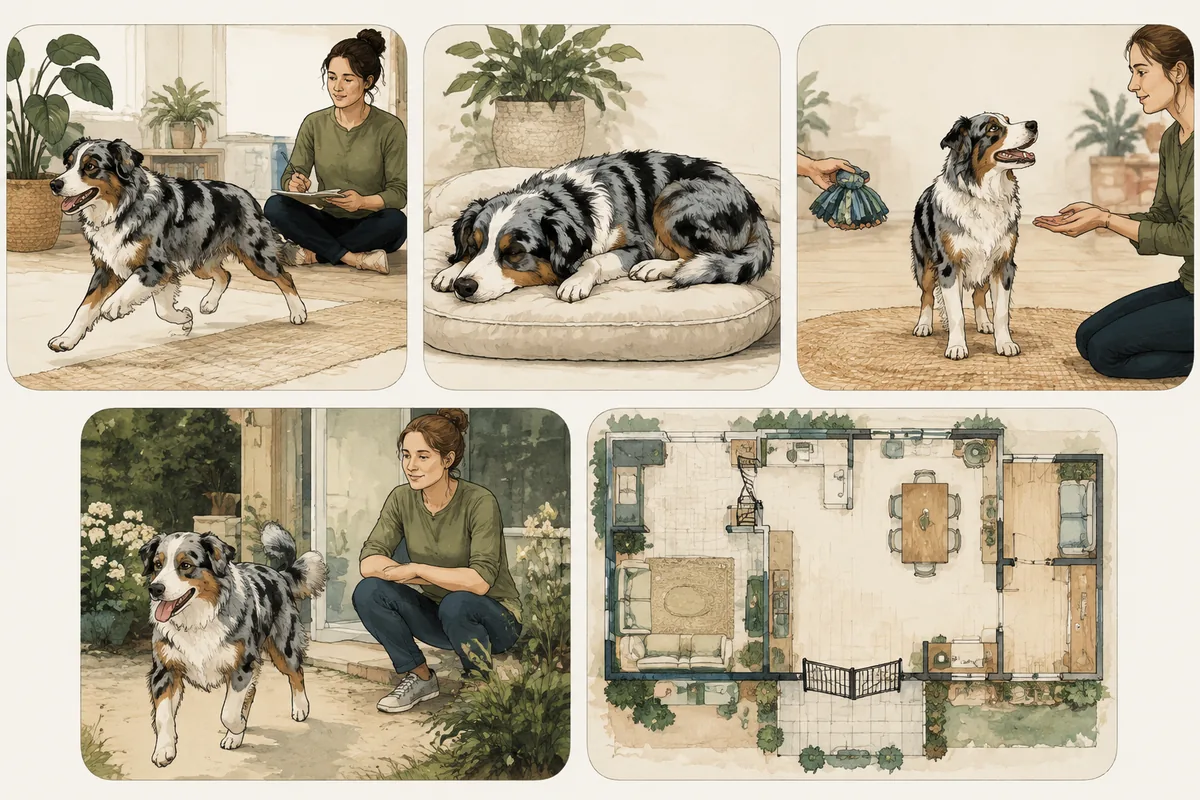
None of these needs replaces the others.
- Exploration, learning, movement, recovery
- What happens when a single one is fed
- Spreading across the day rather than concentrating
Part 3: teach the pause button
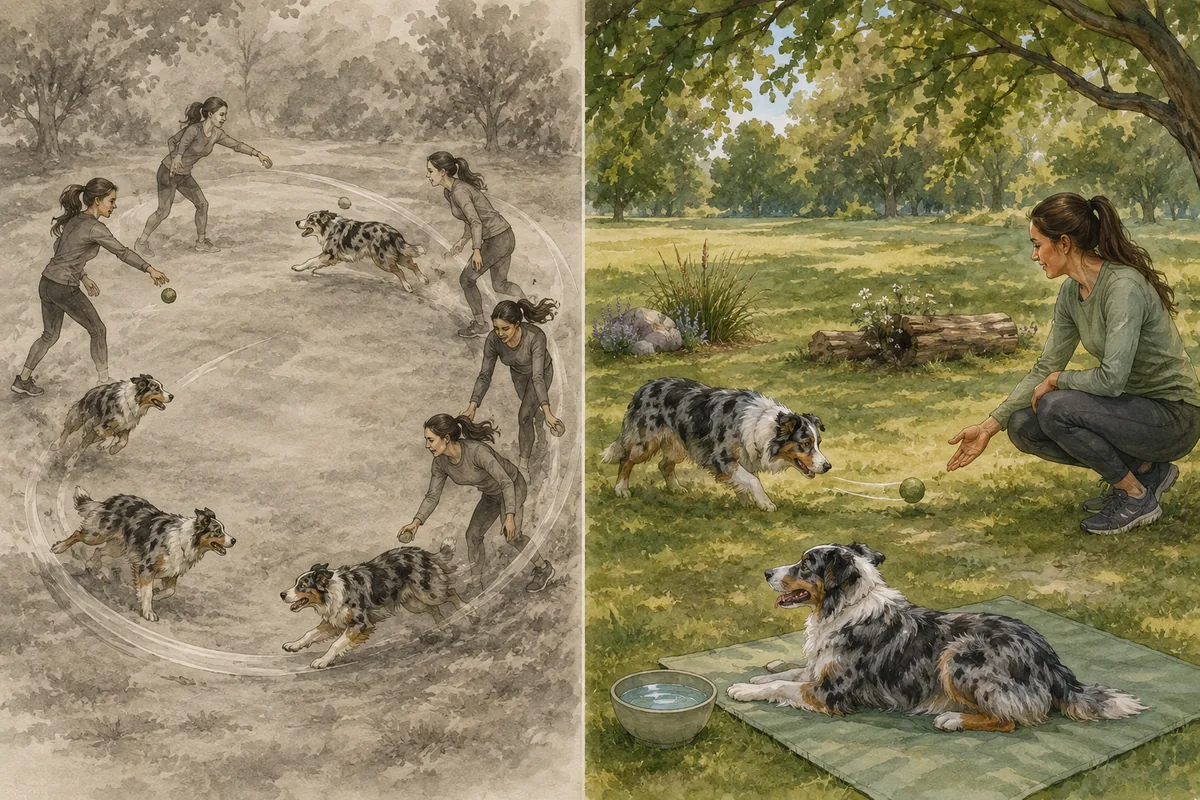
The skill that is almost always missing.
- The stop protocol, step by step
- How to know he has it
- Using it without wearing it out
Part 4: channel chasing and herding
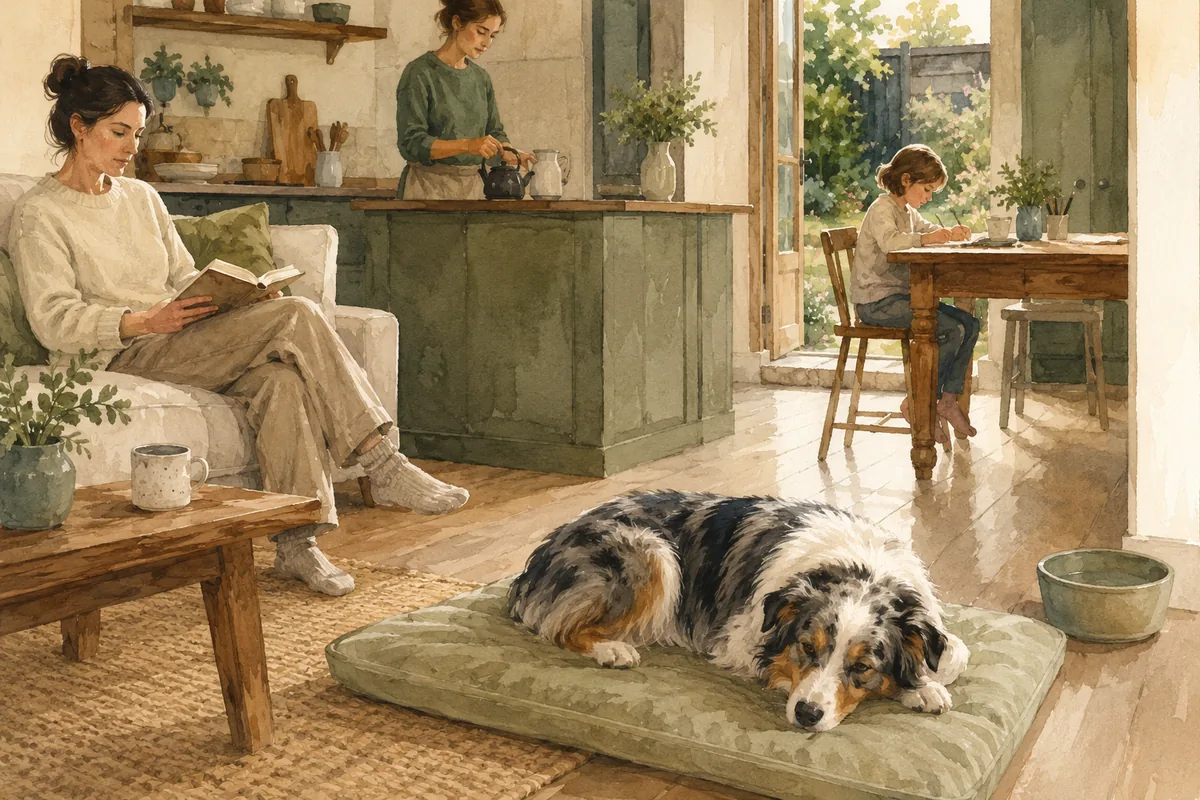
Give an acceptable outlet to what will surface anyway.
- The concrete alternatives to chasing
- Herding the kids and the bikes
- What you must not encourage through play
Parts 5 and 6: useful activities and common mistakes
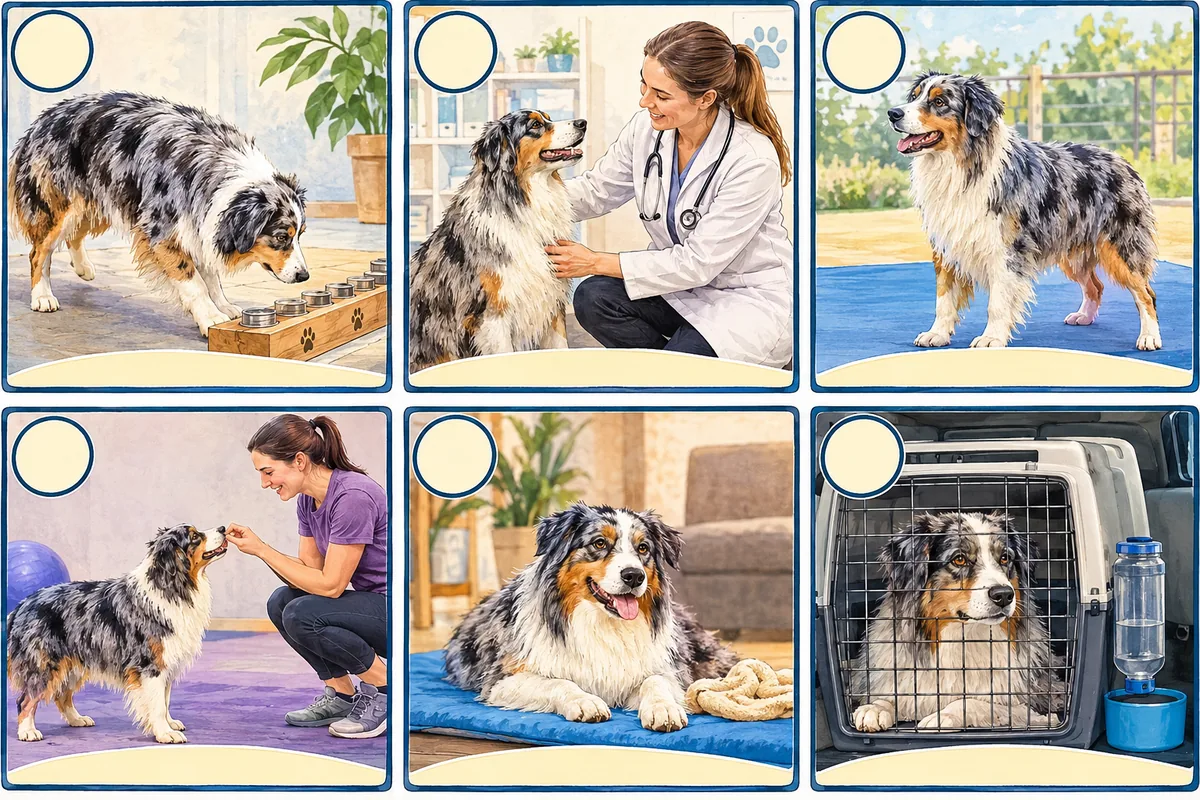
What really helps, and what amplifies without being noticed.
- Activities at home and activities outside
- The habits that build more intensity
- The role of recovery, often forgotten
Part 7: the 4-week plan
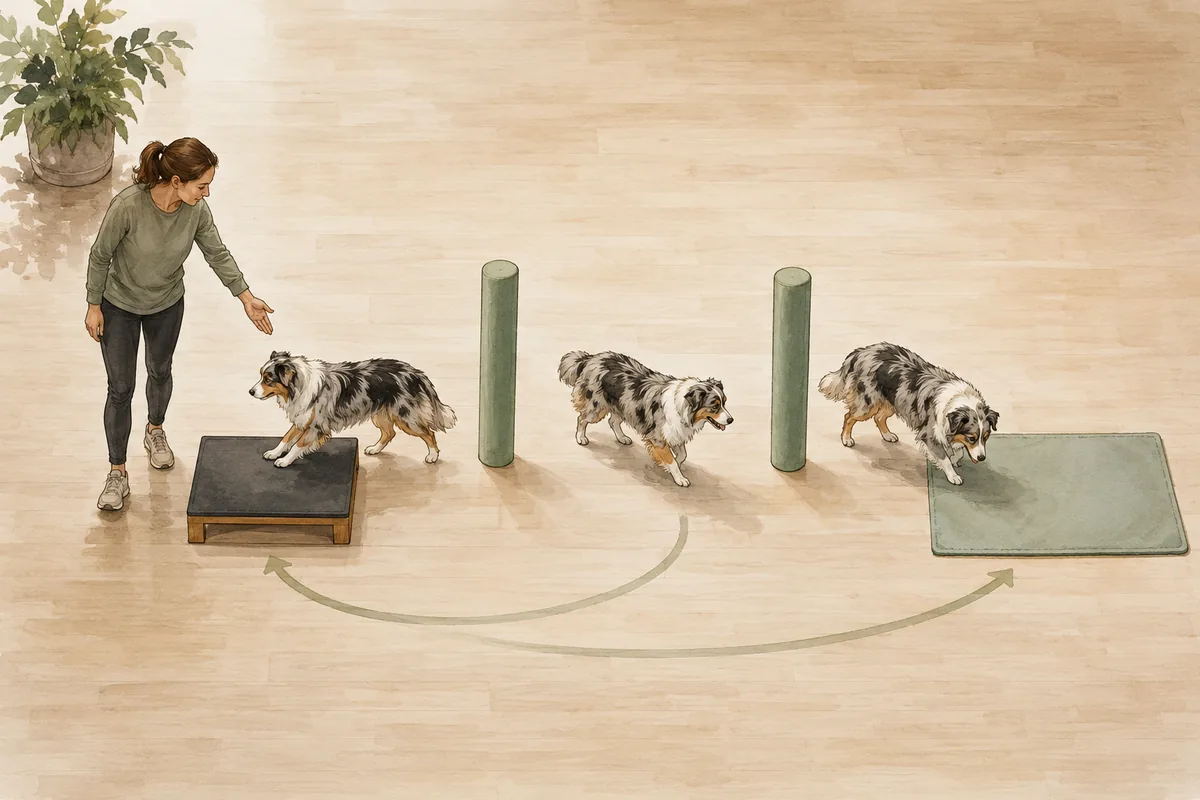
Going from principles to a real schedule.
- A sample week, adjustable
- Twelve troubleshooting situations
- The practical worksheets to print
Here is where the book leads
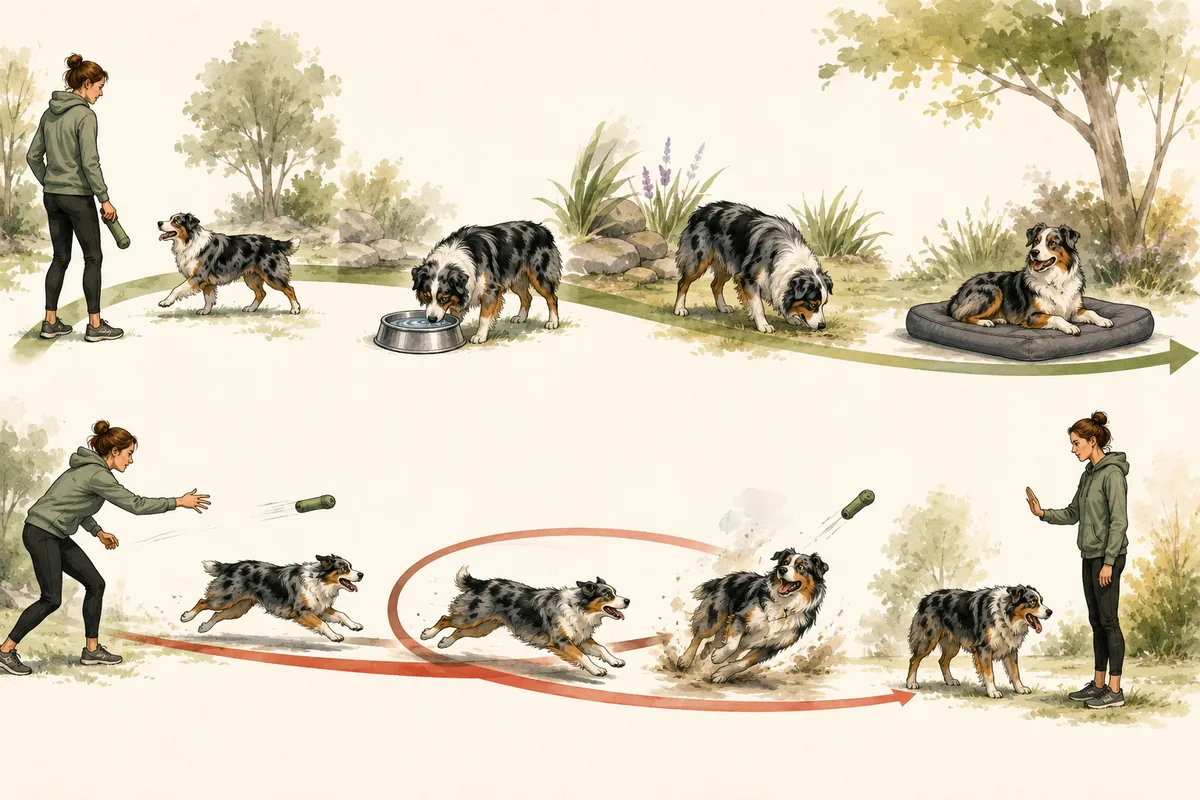
The 4-week plan, an adjustable sample week.
At the end of the 4 weeks, here is what you should have:
- A dog who lets out a sigh and settles after an activity, without looping straight back.
- A stop signal that works at home and outside.
- A spread of 20 to 30 minutes well chosen rather than 2 hours you just endure.
- A concrete alternative to chasing bikes and herding the kids.
Your dog's energy stops being a problem to wear out and becomes a resource to steer.
Here is exactly what you receive
A 64-page PDF, with 30 illustrations drawn for this book, readable on phone, tablet and computer, and printable if you prefer paper in hand.
And
The 4-week plan and the practical worksheets are printable, so you can hold the pace without memorizing everything.
The download arrives by email a few minutes after payment, with a private link. No package, no shipping wait.
Here is everything you get today
- The complete digital book “Channel Your Australian Shepherd's Energy, Every Day”, 7 parts illustrated(value $47)
- The pause button protocol, trainable like an exercise(included)
- The 4-week plan, with an adjustable sample week(included)
- The troubleshooting set of twelve common situations(included)
- The practical worksheets to print(included)
- Total value$86
The price shown on this page is the price charged at checkout. This is a one-time purchase, with no subscription. The product is digital and delivered by email once the payment is confirmed.
100 % digital book to download. Nothing is shipped.
Secure payment by card or PayPal · 30-day guarantee
Our 30-day satisfaction guarantee
Read the book, run the plan. If you feel it did not help you, write to us within 30 days at contact@thepupmethod.com and we will tell you right away how to get your refund.
You do not have to explain yourself. A guide that does not help should not be paid for.
P.S. The trap with this breed is that it makes the wrong setup invisible: he follows, he takes it, he asks for more. That is what raises the bar without anyone noticing.
P.P.S. This book does not replace a veterinarian or a dog trainer when a situation calls for one. It tells you clearly when it is better to ask for help.
Secure payment by card or PayPal · 30-day guarantee