How to get through the first 30 days with your puppy without losing your nights, your sofa and your patience.
A daily plan that says what to install this week, what can wait until next week, and what to leave alone for now. No punishment, no drilling, and without spending your whole day on it.
Keep reading if you want to:
- Prepare the home, the equipment and the household rules before the puppy arrives, instead of repairing afterwards what installed itself on its own.
- Get through the first 24 hours without overloading a puppy who has just left everything behind in a single day.
- Install house training, sleep and meals with readable landmarks, rather than reacting to every accident.
- Understand mouthing for what it is at this age, and know what to offer instead without punishing.
- Build the name, the recall and the first cues in 2-minute steps, in an order that holds up.
- Let your puppy discover the world without overwhelming him, and recognise the moment to go home.
- Have a plan for the first 30 days, and know what to do on the days when the plan does not go to plan.
From: Léa Fontaine
The Pup Method, a step-by-step educational approach built on observation, repetition and positive reinforcement.
Dear future companion of a puppy,
He arrived yesterday. You had pictured everything except the tiredness. He cries at night, he toilets indoors right after coming in from the garden, he mouths the children's hands, and you catch yourself looking for an answer on your phone at midnight.
Every search gives you a piece of advice, and the next one says the opposite:
- "Let him cry, he will get used to it." A puppy who has just left his mother and his littermates does not learn to reassure himself because he is ignored. What he mostly learns is that nobody comes.
- "Take him out every hour and he will be clean." Frequency helps, but it says nothing about the moment to go out, about what you do outside, or about what happens when you come back in. Plenty of families go out 12 times a day and barely progress.
- "He mouths because he is testing you." A puppy mouths because he explores, because his teeth are coming through and because that is how he has played since birth. Seeing a test in that gives you nothing to actually do.
So you try one method on Monday, another on Wednesday, and you change again on Friday because the first one was not working fast enough. The puppy, meanwhile, receives 3 different rules in 5 days.
The night I realised I was going about it backwards

The arrival, as the book explains it: less of a show, more landmarks.
My first puppy was called Nougat. On the third night, at 4 in the morning, I was sitting on the floor in the hallway, exhausted, wondering what I had missed. I had read dozens of articles. I had a puppy who was crying, a rug to clean and a different rule for every person in the house.
The next day, instead of hunting for one more trick, I did something else: I took a sheet of paper and wrote down what happened just before each problem, and what happened just after.
In 3 days, that sheet showed me what no article had. Nougat was not toileting indoors at random: he did it 18 minutes after every meal, exactly when I left him alone in the kitchen. He was not crying at night out of stubbornness: he cried when the hallway door was closed, never when it was ajar.
I did not have a puppy problem. I had an organisation problem, and organisation is something you write down in advance.
This book came out of that sheet of paper. It contains no tricks. It contains an order: what you install on the first day, what you expect by the seventh, and what you must not ask for before the fifteenth.
The first month does not build commands, it builds habits
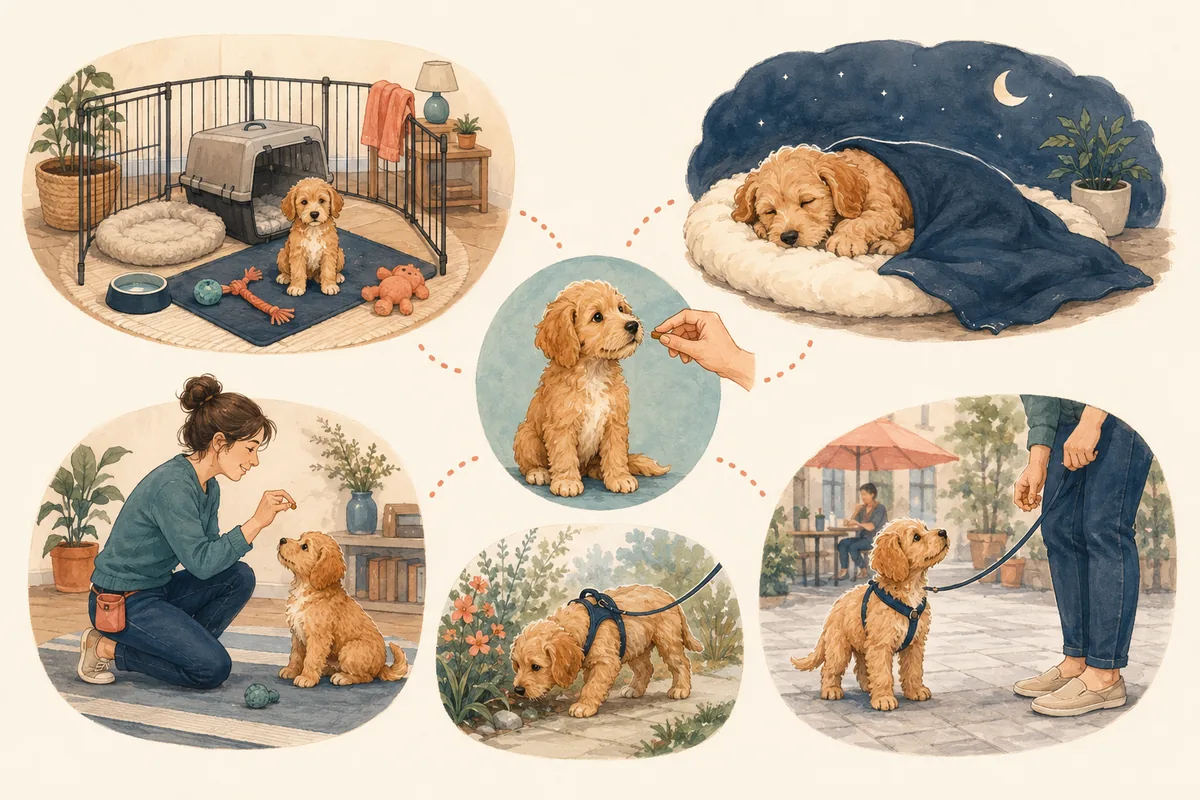
The map of the first month: what gets worked on, and when.
During these 30 days, your puppy is not first learning to sit. He is learning where people sleep, where he toilets, what happens when he mouths a hand, whether the outside world is manageable, and whether he can count on you when something worries him.
All of that installs itself even when nobody has decided to teach it. A puppy who gets attention by jumping learns to jump. A puppy left alone facing a hallway full of noises learns that the hallway is a problem. The learning never stops, it simply happens without you if you do not organise it.
What you install in the first month will become the adult dog's reference point, for 10 to 15 years.
That does not mean you have to be perfect. A puppy copes very well with the mistakes of a consistent human. What he copes badly with is a rule that changes depending on the person, the hour or how tired whoever is applying it happens to be.
At this stage, you have 2 options
The second option does not take more time. It asks you to decide in advance, once, instead of deciding 20 times in a rush. That is exactly what this book does for you.
The P.A.T.T.E. method
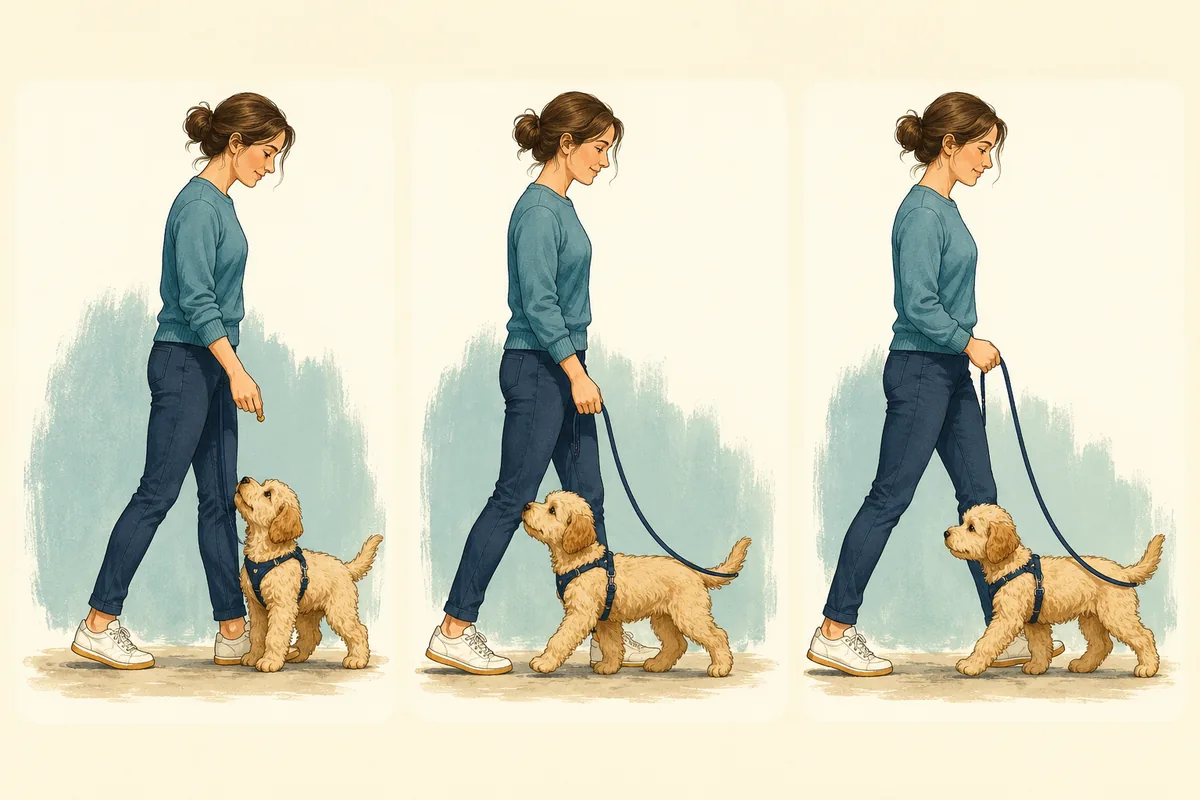
Every exercise in the book is adjusted with the same 5 checks.
Every difficulty of the first month is solved with the same 5 checks. That is the thread running through the book, and it is what saves you hunting for a new trick every time an exercise stalls.
- P for Prepare. Put the shoes away before they become a toy, fit the gate before you need to separate him, choose a quiet area before the puppy is exhausted. The environment decides the success before you do.
- A for Associate. The harness announces treats, your return announces something pleasant, his name announces that it is worth turning towards you. What announces counts as much as what follows.
- T for Timing. Mark the right instant within a 1 to 2 second window, so the reward is linked to the right behaviour and not to the one after it.
- T for Transfer. Do the exercise again elsewhere, adding one single difficulty at a time: the distance, the duration or the distraction, never all 3 together.
- E for Everyday upkeep. Space out the rewards, keep the sessions short, and know how to go back deliberately to an easier level after a setback.
When an exercise does not work, you do not change method: you read the 5 letters again and find the one that is missing. More often than not, it is the P or the T.
The 30-day plan
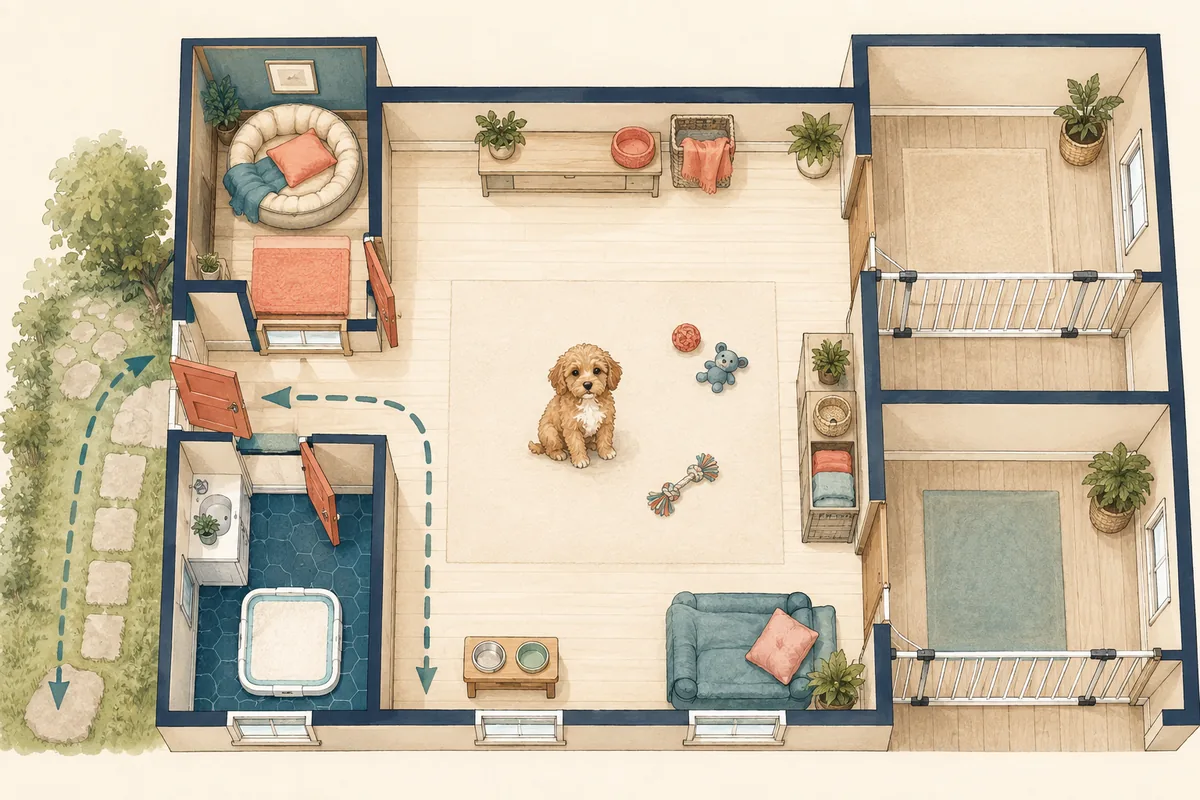
The traffic plan, to be drawn before the puppy even arrives.
The book divides the first month into 6 stages that follow on from each other, each one preparing the next. You only move to the next stage once the previous one holds, and you know what to do if it does not.
- Before the arrival. The traffic plan through the home, the equipment that solves a real problem, and the meeting of the household's humans to set the rules before you have to negotiate them.
- Day 1. Less of a show, more landmarks: the arrival, the first meal, the first night, and what you must not ask for yet.
- Days 4 to 7. House training with a real rhythm, mouthing handled by replacement, and the first learning tools.
- Days 8 to 14. The name, the recall at 2 metres, accepted handling, and the first reflexes that make living together simpler.
- Days 15 to 21. Discovering the world in doses, with the criterion that tells you whether to carry on or to go home.
- Days 22 to 30. The transfer: doing elsewhere, with a little more distraction, what already works at home.
2 further parts cover what most guides leave out: what to do when the month does not follow the plan, and how to choose competent help if your situation calls for it.
Just imagine for a moment...
- Getting up in the morning knowing what gets worked on today, and what is not yet in season.
- Getting through a hard night without wondering whether you are ruining everything.
- Seeing a toileting accident and knowing exactly which variable to adjust, instead of blaming yourself.
- Taking your puppy out for 10 minutes and going home because you spotted the right signal, not because the walk ended badly.
- Giving the other people in the household, and the children, 3 simple rules that everyone actually keeps.
"Will it work for me?"
I do not have my puppy yet, is it too early? This is the best moment. The first part of the book is meant to be read before the arrival, and it is the part that prevents the most problems: the home plan, the equipment, the household rules.
My puppy is already 4 months old, is it too late? No. The plan still holds, you will simply move faster through some stages. The 5 letters of P.A.T.T.E. work at any age, including with an adult dog.
I work all day. The sessions last 2 to 5 minutes, several times a day. The book is written for people who do not have an hour of training every day, and it says clearly what is not realistic in that case.
He is an adult rescue dog. The 30-day plan applies to an adoption too: the landmarks, the house training, being alone and the trust are built in exactly the same way.
The good news: none of this is complicated
You need neither expensive equipment nor an hour of training a day. A few minutes several times a day, a suitable reward, a quiet place, and the same rule kept by everyone are enough for the first weeks.
- You do not need to punish a behaviour that is normal for his age.
- You do not need to demand full house training in 7 days.
- You do not need to take him everywhere straight away for him to be sociable.
What you mainly need is to know in what order to do things. That is the one real advantage of a plan: it stops you working on the right thing at the wrong moment.
I am pleased to introduce the digital book:

Get the First 30 Days With Your Puppy Right: a daily plan to install the right habits without exhausting the whole household.
This book is a manual for doing, not a treatise. Each part explains what is going on, gives you what to do, then offers a short exercise to carry out that same day. You can read it from start to finish before the puppy arrives, or open it straight at the part matching the day you are on.
It is organised into 8 progressive parts, 76 pages and 32 illustrations, completed by printable appendices, a practical glossary and an annotated bibliography. This is a digital book to download, not a paper book shipped to your door.
Here is a preview of what you are going to learn
8 parts that link preparation, everyday life, learning and transfer.
Part 1: preparing an arrival that does not force you to repair things afterwards
What gets decided before the big day costs far less than what gets corrected afterwards.
- Draw the puppy's traffic plan through the home, room by room
- Choose the equipment that solves a real problem, and ignore the rest
- Hold the meeting of the humans before training the puppy
- Prepare the vet, the travel and the interactions with children
Part 2: the first 24 hours

The first day is not taught, it is got through with as little damage as possible.
- An arrival with no show, no parade of visitors and no overload
- The first meal without changing everything at once
- The first night: what genuinely helps, and what installs a problem for months
Part 3: days 4 to 7, house training, mouthing and the first tools
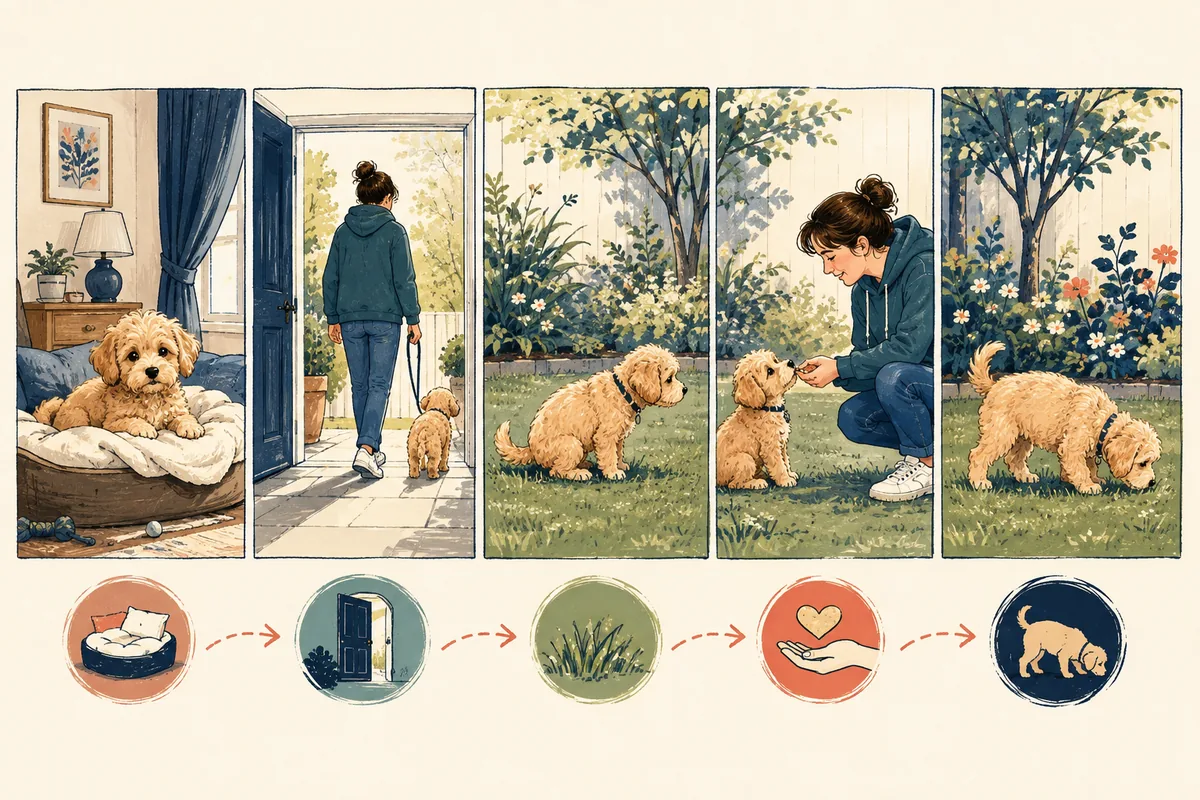
The 2 subjects that break families, handled with no punishment and no magic.
- A rhythm of trips outside based on what the puppy does, not on the clock alone
- What you do outside, and above all what you do when you come back in
- Mouthing replaced rather than suppressed, with an alternative always available
Part 4: days 8 to 14, building the first reflexes
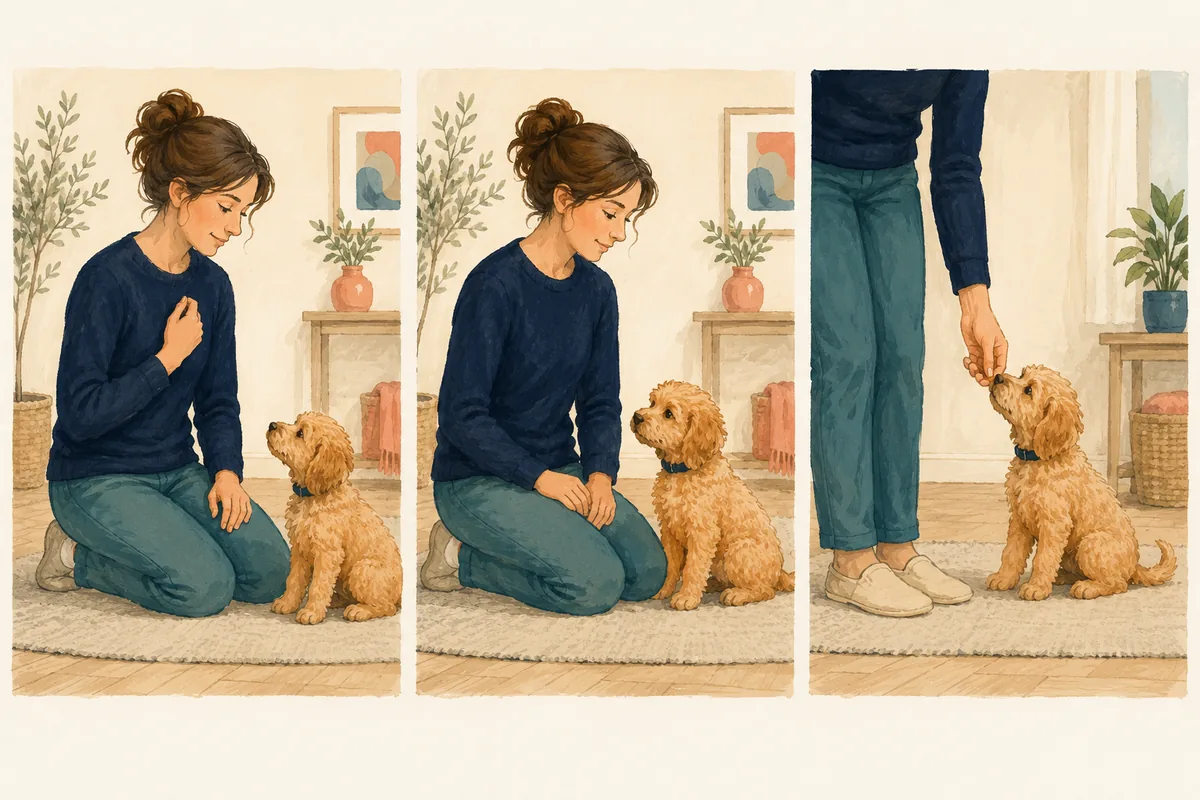
The learning that makes everything else simpler, in the right order.
- The name that turns his head, then the recall at 2 metres
- Accepted handling, useful for life at the vet
- Sessions of 2 to 5 minutes, spread through the day
Part 5: days 15 to 21, discovering the world without being overwhelmed
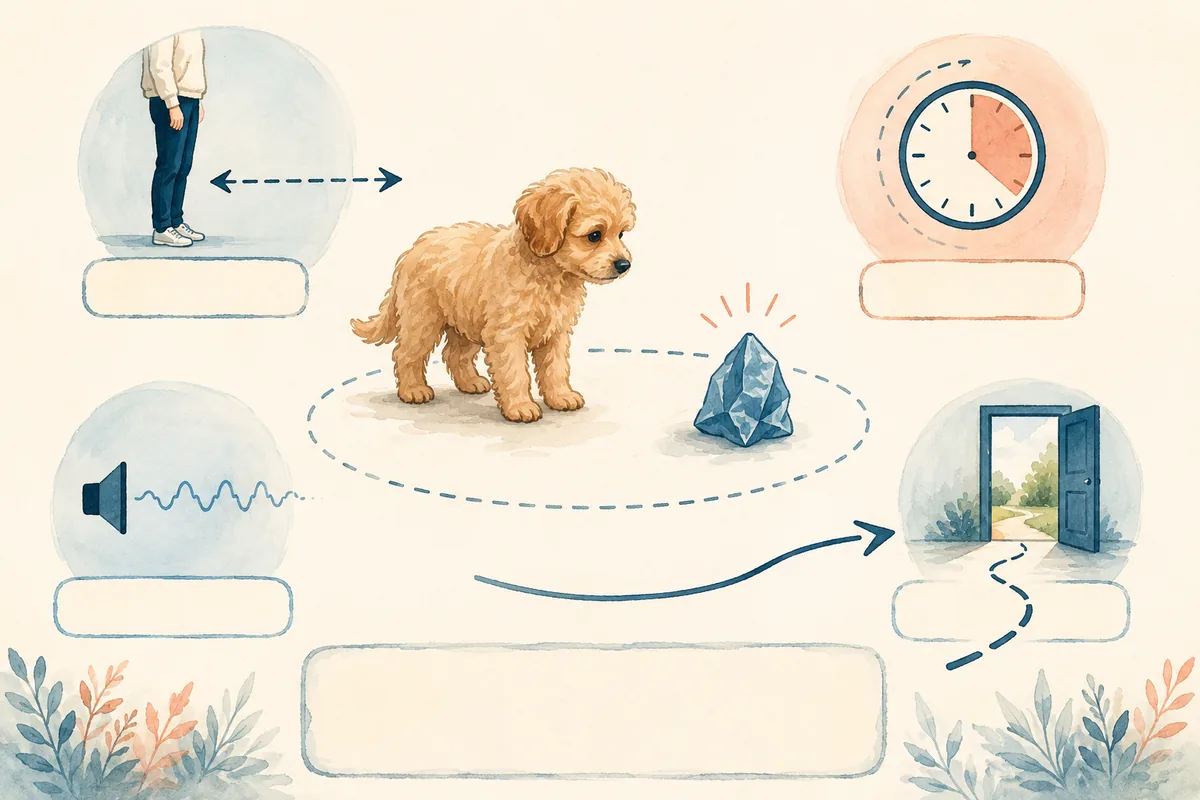
Socialisation is not a pile of experiences, it is a series of successful experiences.
- Set the dose of an outing by what the puppy shows, not by a target
- Recognise the moment to go home, before the situation degrades
- Prepare the meetings with other dogs and with strangers
Part 6: days 22 to 30, transferring without losing the foundations
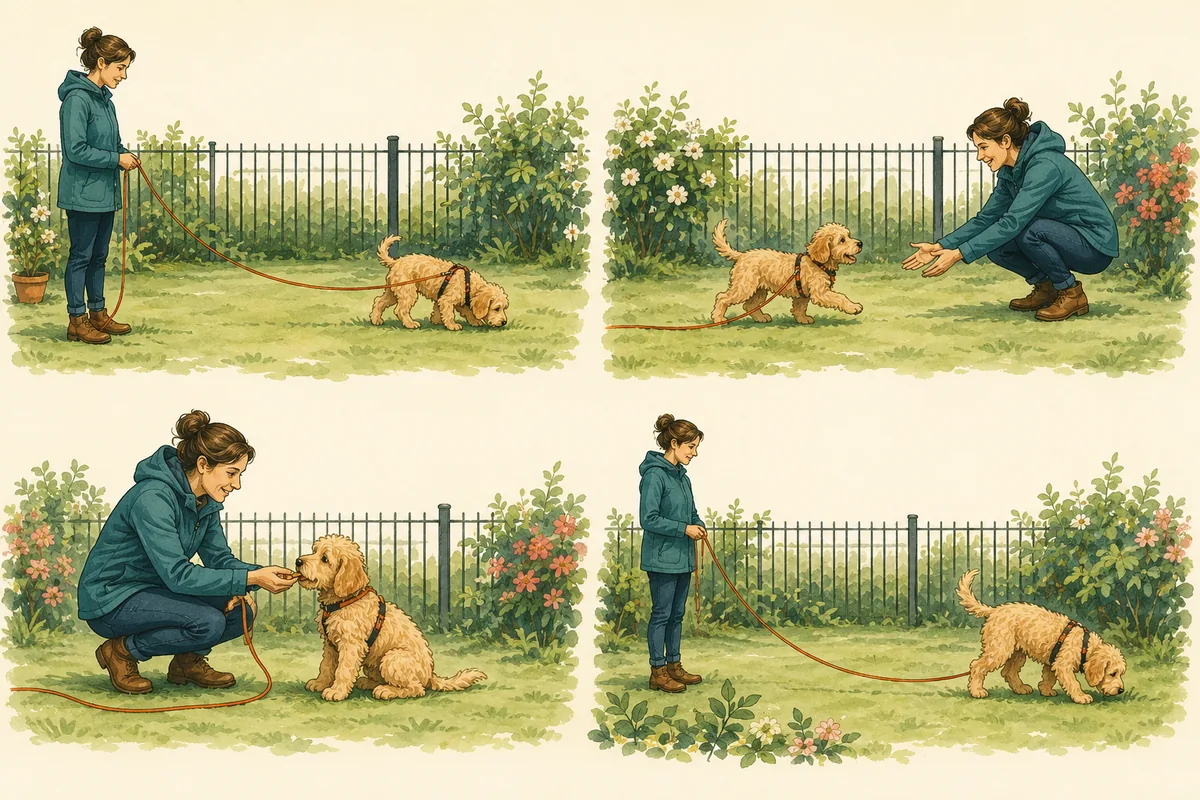
Succeeding in the living room does not mean succeeding outdoors. The transfer is organised.
- Redo elsewhere what already holds at home, one difficulty at a time
- Go back deliberately to an easier level after a setback
- Maintain what has been learned once the novelty wears off
Parts 7 and 8: when the plan does not go to plan
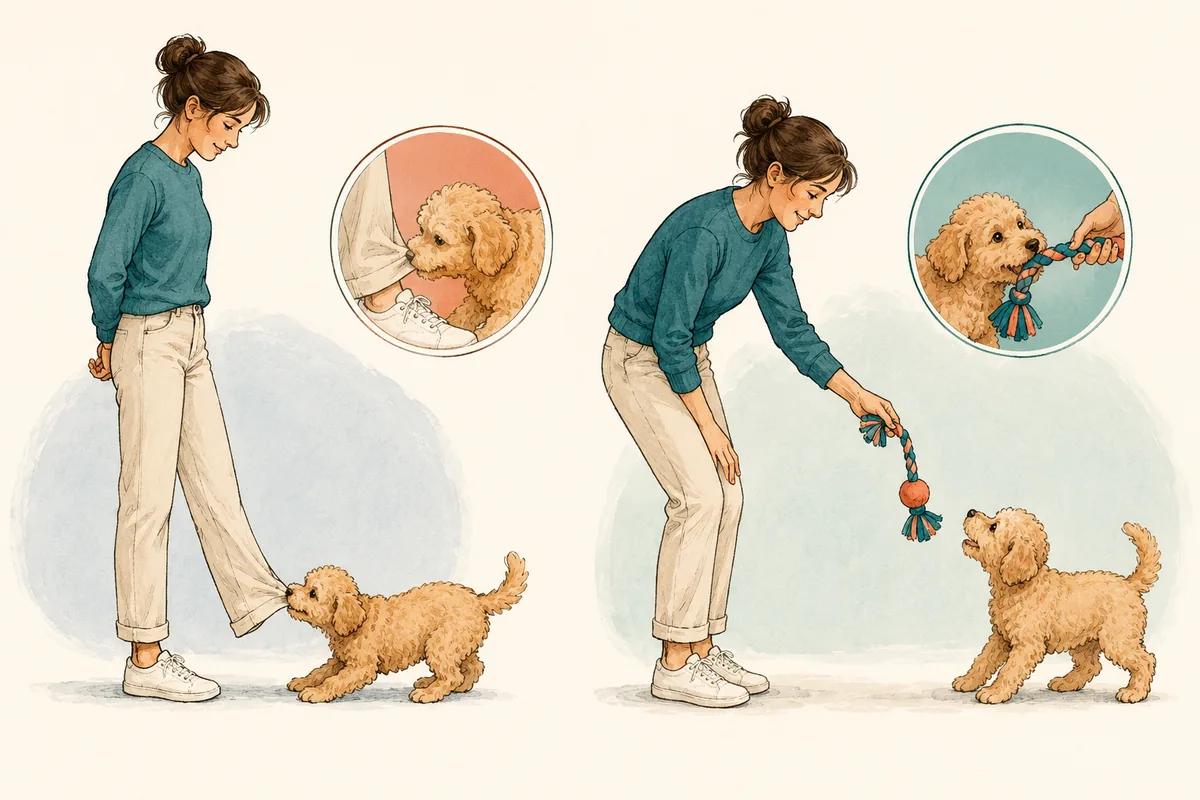
What the guides avoid writing down, and which happens to almost everyone anyway.
- The common blockages of the first month and what they actually indicate
- The situations where you stop improvising and ask for help
- How to recognise a competent professional who respects the dog
Here is where the book leads
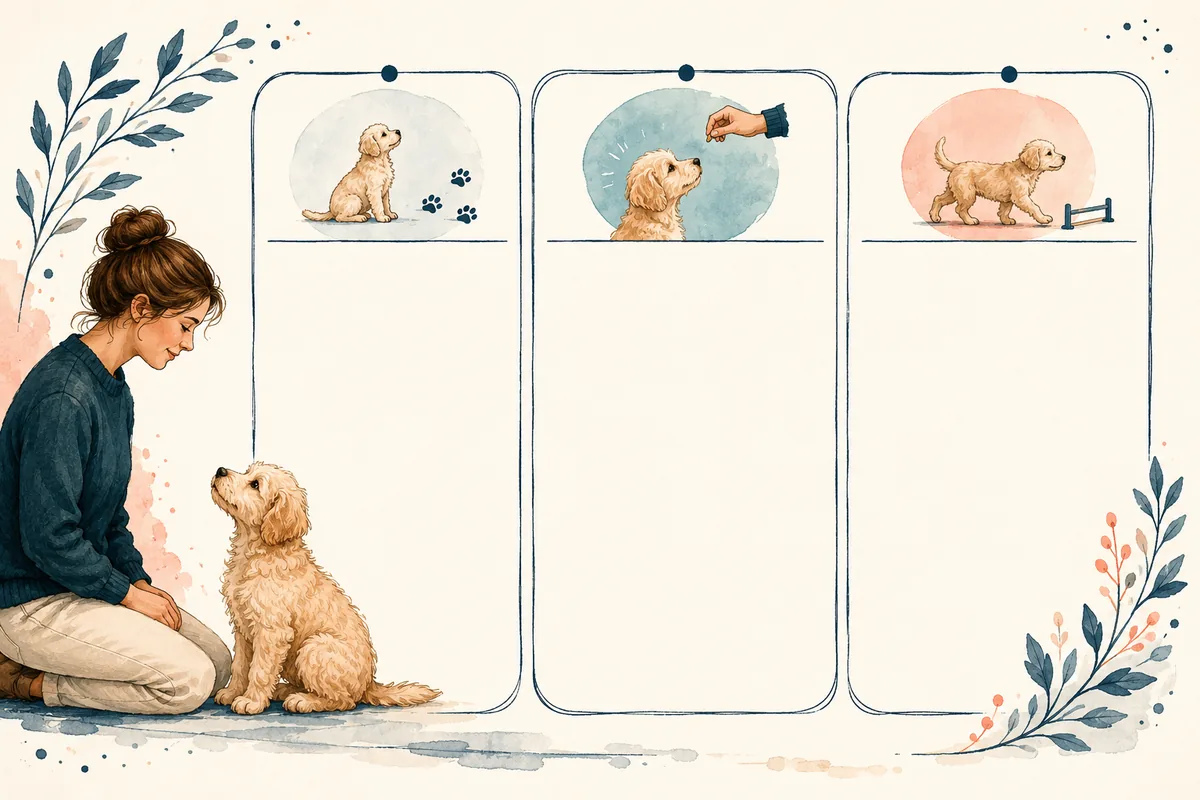
The review on day 30: what is in place, what is still to be built.
By day 30, you are not supposed to have a perfect dog. You are supposed to have 4 things, and the book makes you check them one by one:
- A puppy who sleeps more or less through the night, and who can settle during the day.
- House training well under way, with accidents that become rare and explainable.
- A name that turns his head and a recall that works over a short distance.
- A household where everyone applies the same rule, children included.
From there, everything else becomes far simpler. The following months are no longer about repairing, but about widening what already holds.
Here is exactly what you receive
A PDF of 76 pages, with 32 illustrations drawn for this book, readable on phone, tablet and computer, and printable if you prefer paper to hand during the exercises.
And
The printable appendices are designed to be stuck on the fridge or slipped into a pocket during outings, where you actually need them.
The download arrives by email within minutes of the payment, with a private link. No parcel, no waiting for delivery.
Here is everything you get today
- The digital book "Get the First 30 Days With Your Puppy Right", 8 parts and 76 illustrated pagesvalue $47
- The 30-day calendar, to follow and to adapt to the real puppy in front of youvalue $24
- The printable appendices: house-training log, household rules, preparing the vetvalue $15
- The practical glossary, to understand the terms without pointless jargonincluded
- The annotated bibliography, if you want to check and go furtherincluded
- Lifetime access to the book, on the device of your choiceincluded
- Total value$86
The price shown on this page is the one charged at checkout. This is a one-off purchase, with no subscription. The product is digital and delivered by email once the payment is confirmed.
100 % digital book to download. Nothing is shipped.
Secure payment by card or PayPal · 30-day guarantee
Our 30-day satisfaction guarantee
Read the book, apply the plan through your first weeks. If you feel it has not helped you, write to us within 30 days at contact@thepupmethod.com and we will tell you straight away how to get your refund.
You do not have to justify yourself. A guide that is of no use should not be paid for.
P.S. The first 30 days do not happen twice. What your puppy installs now, in house training, in sleep, in confidence and in the way he asks for things, will serve as the reference point for years. You can let it install itself, or you can decide what gets installed.
P.P.S. This book does not replace a vet or a dog trainer when a situation calls for one. It helps you organise everyday life and tells you clearly when it is better to ask for help.
Secure payment by card or PayPal · 30-day guarantee