How to pass other dogs without the walk turning into a lead fight, and without crossing the street every time.
Calm is not decided at the moment you pass. It is prepared beforehand, at a distance where your dog can still think.
Keep reading if you want to:
- Understand why your dog reacts to some dogs and not to others, without concluding that he is badly trained.
- Spot the tipping point, that precise instant when he no longer hears you, and act before he gets there.
- Set up escape routes that actually work, by rehearsing them when no dog is in sight.
- Change what another dog's presence announces to him, instead of simply forbidding him to react.
- Organise real passing exercises, at the right distance, rather than putting up with encounters.
- Know what to do when a dog appears out of nowhere, which neither theory nor patience is enough to handle.
From: Léa Fontaine
The Pup Method, a step-by-step educational approach built on observation, repetition and positive reinforcement.
Dear walker who scans the pavements,
You know the scene. You are walking quietly, then you spot a shape at the end of the street. Your body stiffens before your dog's does. You shorten the lead, you speed up, and it all plays out in a few seconds.
After a few episodes like that, you always get the same advice:
- "You need to socialise him, take him to meet other dogs." Multiplying encounters when every one of them goes badly only trains what goes badly. What counts is not the number of dogs passed, it is the number of passings that went well.
- "Do not reward him, you are encouraging the reaction." A barking dog is not doing arithmetic. What you change is what another dog's presence announces to him, and that is worked on before the reaction, not during it.
- "Pull on the lead and walk on." The tension on the lead lands at the exact moment he sees the other dog. It risks adding discomfort precisely where you wanted calm.
So you change your times, you pick empty streets, you turn back earlier and earlier. The walk becomes an avoidance operation, and your dog's world shrinks week after week.
If you recognise yourself, remember this:
The day I understood I was acting too late
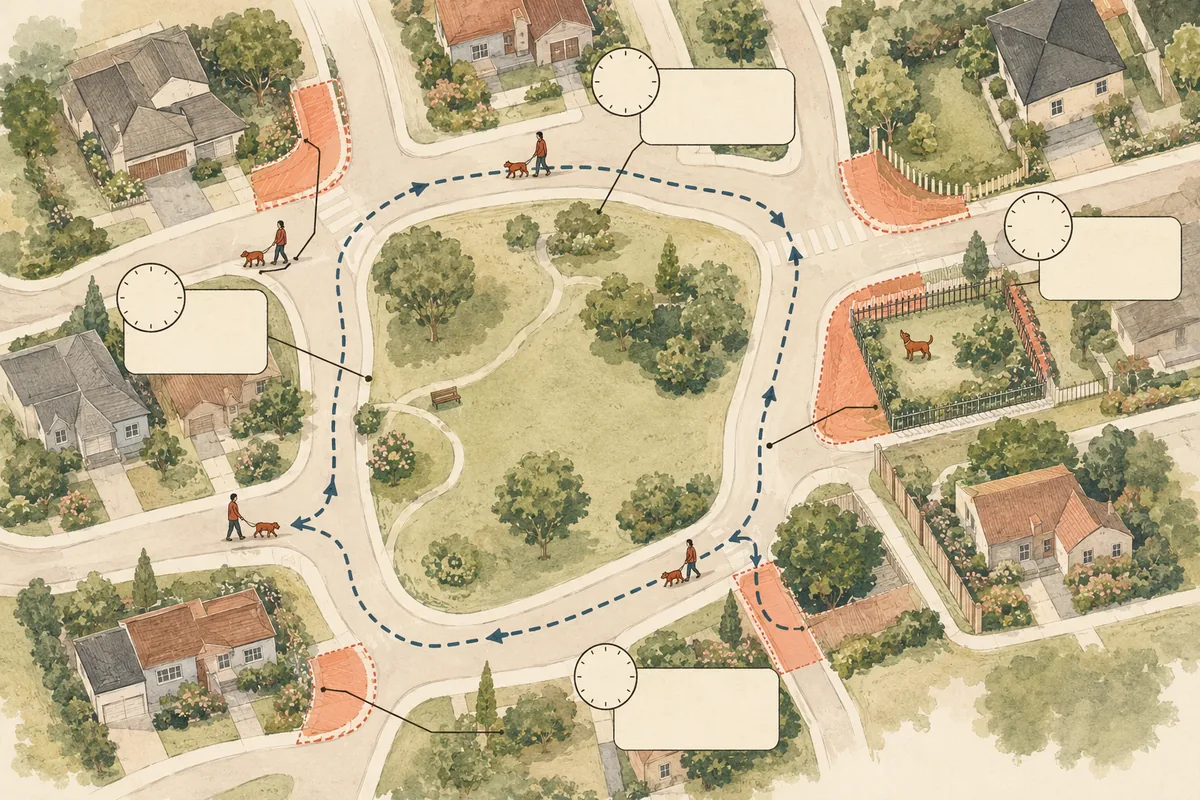
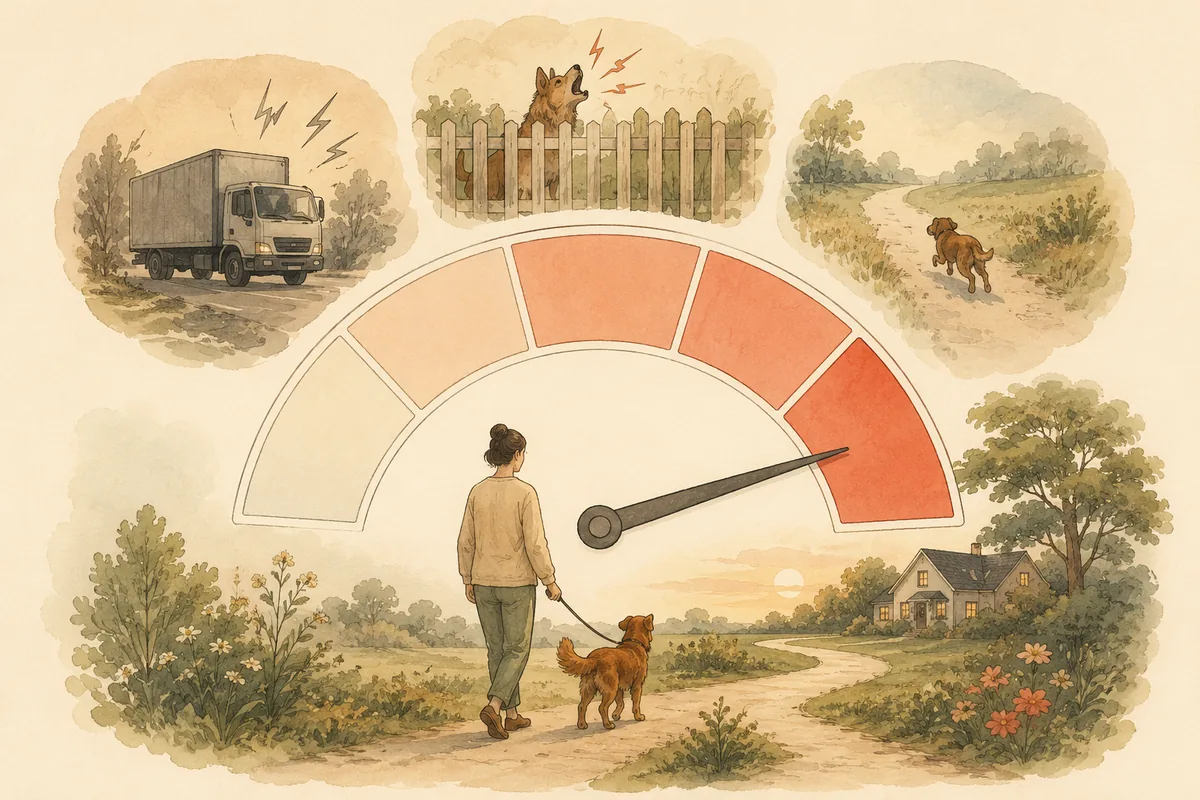
The trigger map: what makes your dog react, and at what distance.
For months I did the same thing: I saw a dog coming, I shortened the lead, I spoke louder, and it always ended the same way.
One afternoon, I decided to do nothing but watch. Walk after walk, I noted the exact moment my dog changed. Not the moment he barked: 4 to 6 seconds before.
An ear that swivels. A body that freezes for half a second. A stare that locks on. Always the same signs, always in the same order.
I was not a few seconds too late. I was 15 metres too late.
From the moment I started acting before that point, everything changed. Not in a day, but the first walk with no incident came in under 2 weeks.
The problem is not the passing, it is what comes before it
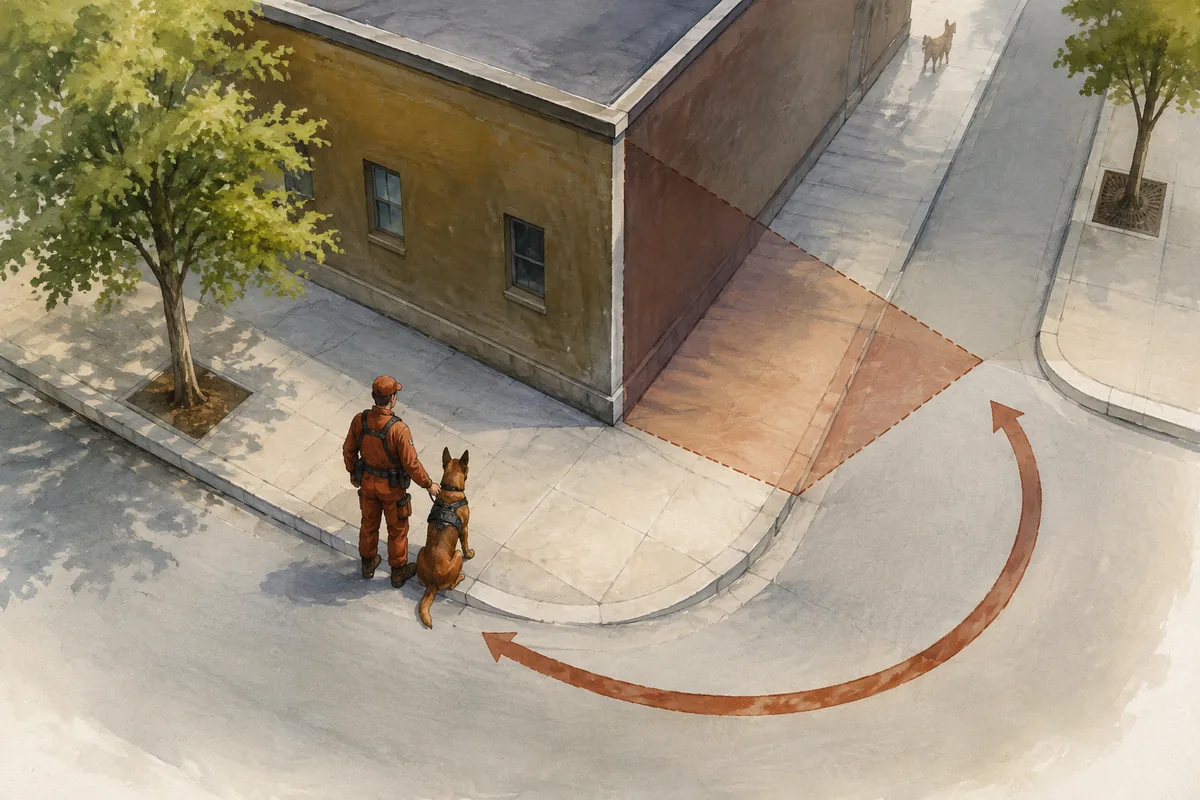
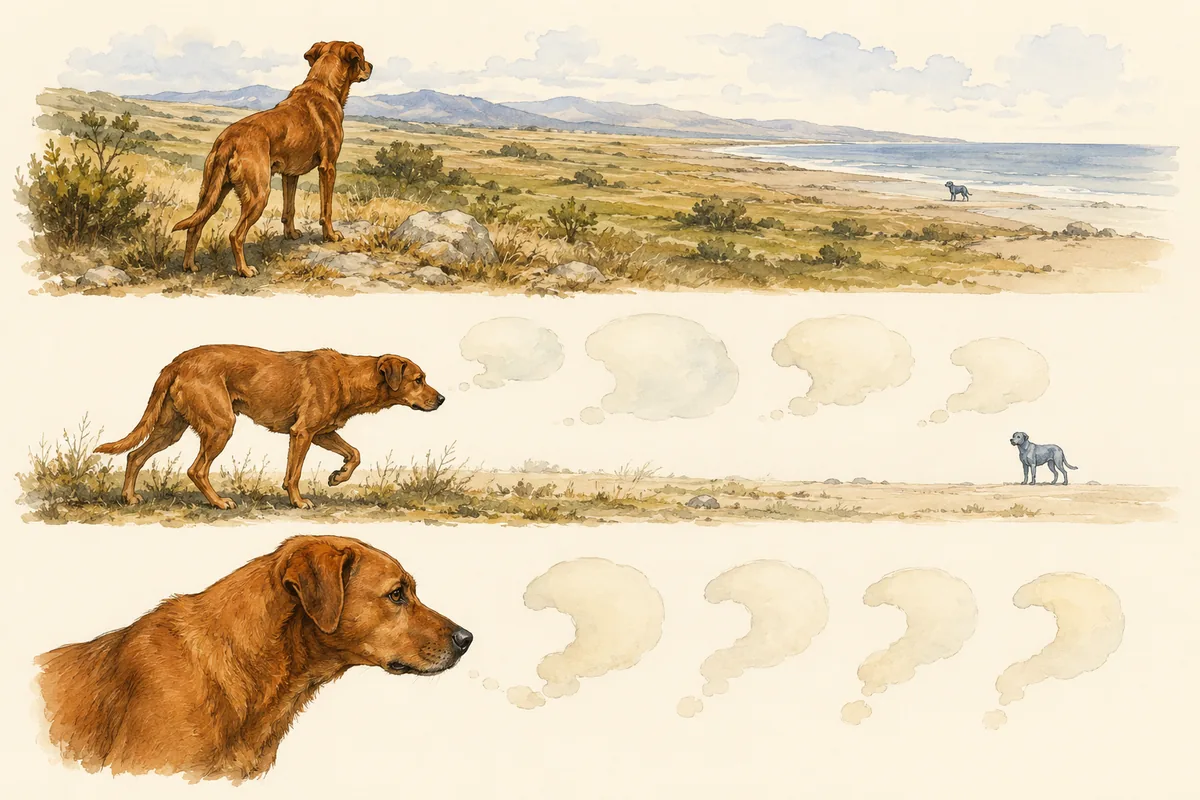
The blind angle: what your dog sees before you do.
Between the moment your dog sees the other one and the moment he reacts, something almost always happens: an ear that moves, a body that freezes, a stare that locks on. That moment lasts a second or 2, and it is the only one where you still have a hold.
Past that point, your voice no longer carries, the treat holds no interest and the lead only adds constraint. That is not disobedience, it is simply too late.
So all the work consists of stepping back one notch: more distance, less surprise, and an exercise your dog can succeed at before the passing happens.
You never work on the passing itself. You work on the distance at which your dog is still able to hear you.
At this stage, you have 2 options
The second option takes patience over the first 2 weeks. After that it makes ordinary walks possible, which avoidance never does.
The progression over 6 weeks
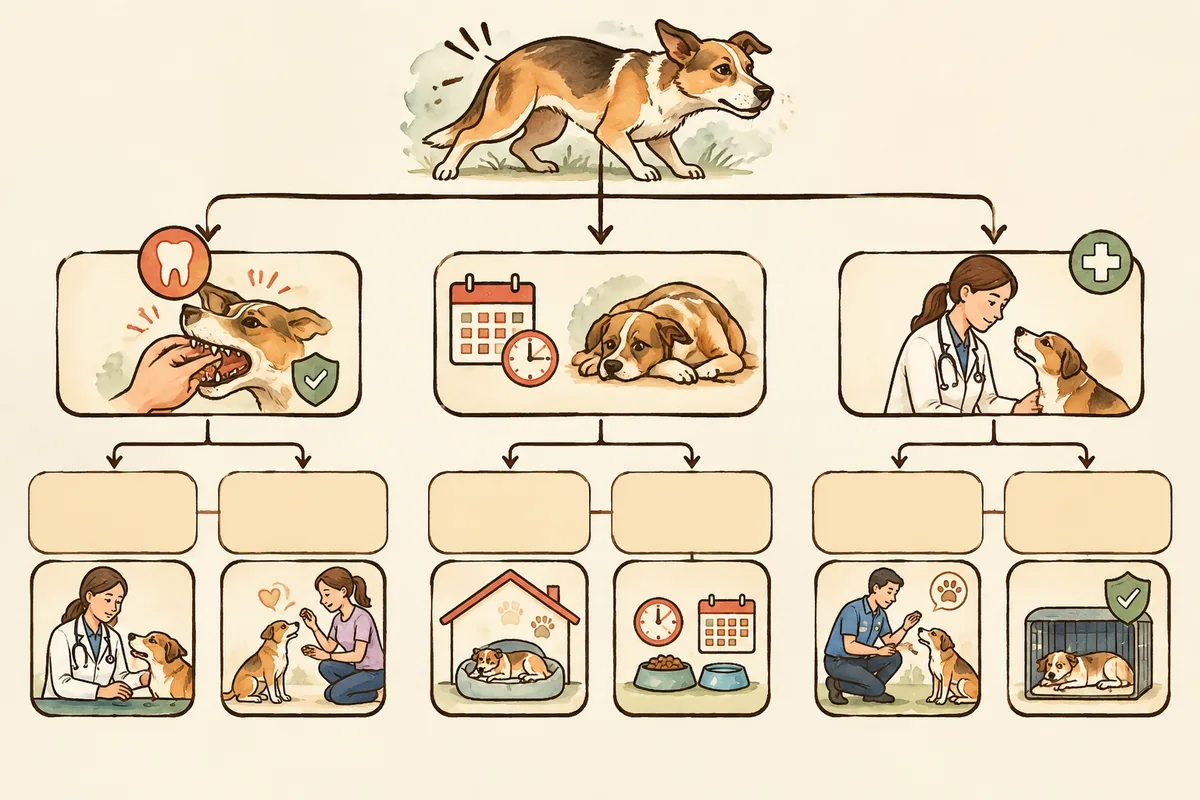
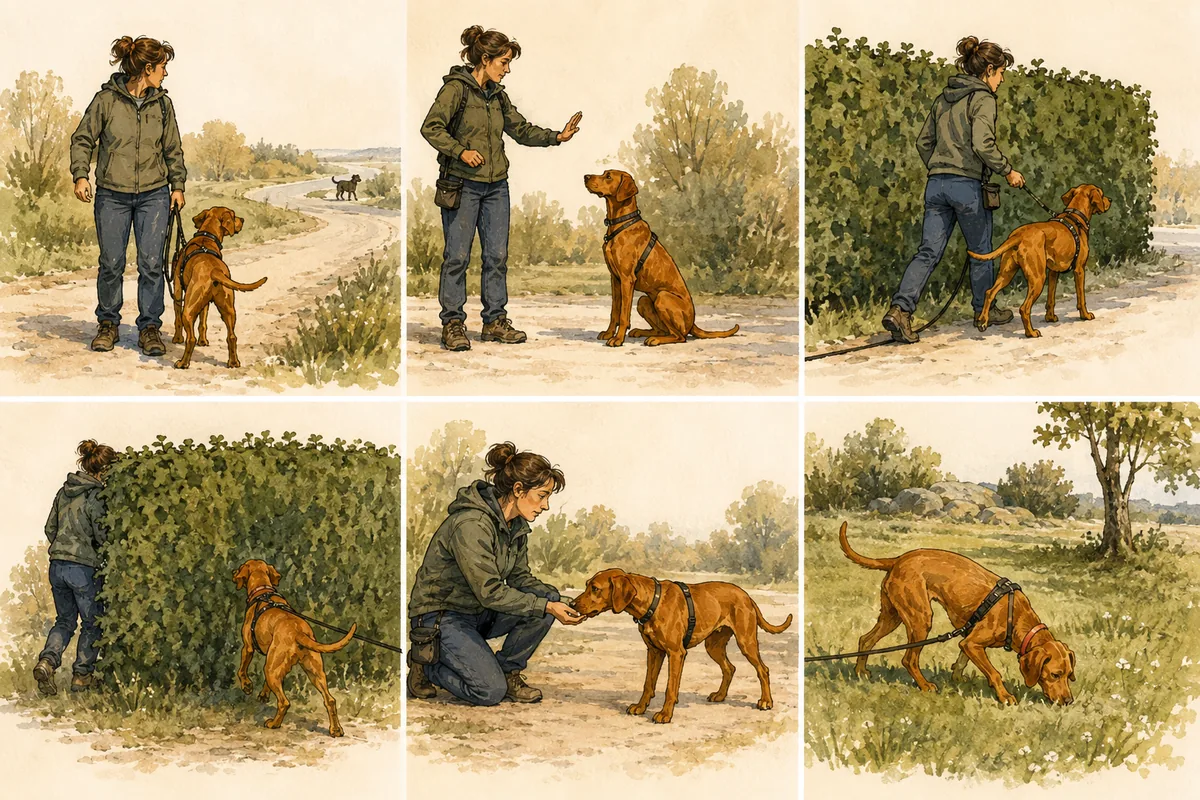
The passing arc, the path that avoids the head-on meeting.
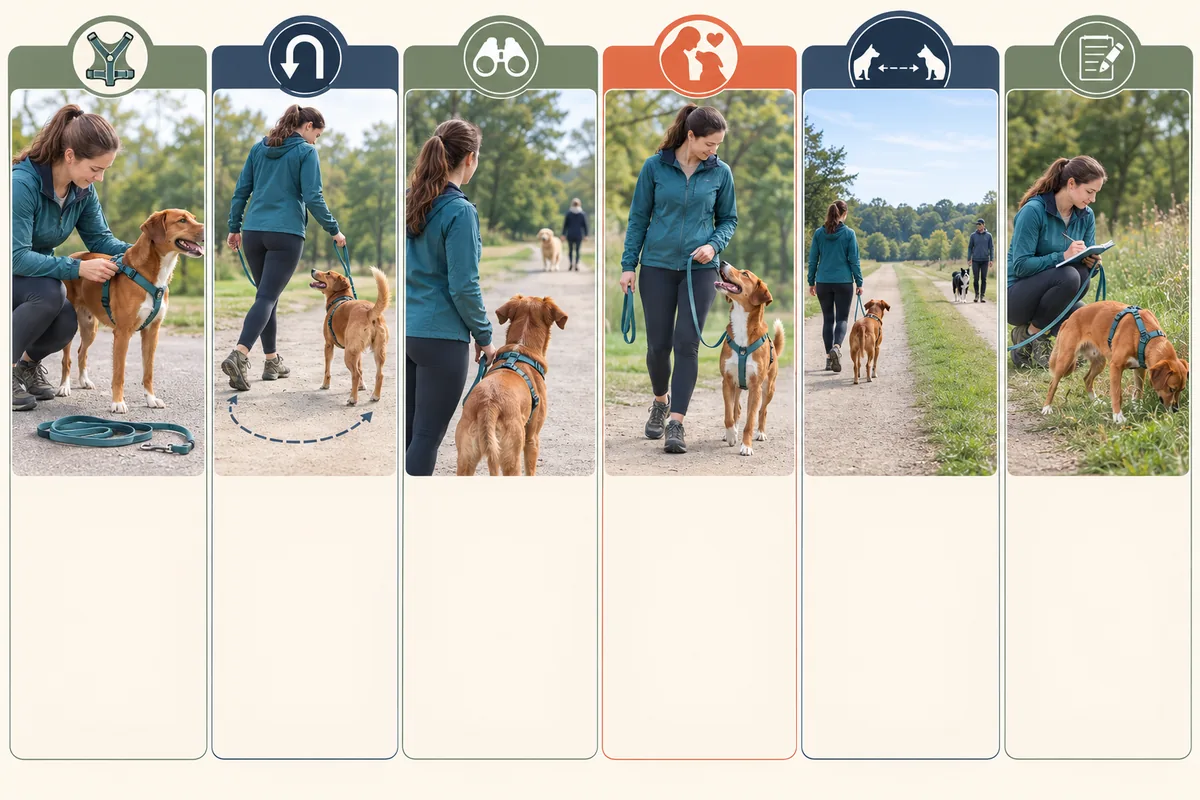
The book organises the work in an order that skips no stage, because each one makes the next possible.
- Making things safe first. The equipment, the way you hold the lead and the rules for going out, so no session can go wrong while you learn.
- Reading the tipping point. Recognising the signals that come before the reaction, in YOUR dog, not in a general table.
- Setting up the escape routes. The turn, the call and the wide detour, rehearsed calmly, with no dog in sight.
- Changing the announcement. Making the sight of a dog in the distance announce something pleasant, at a distance where that is still possible.
- Organising real passings. Prepared exercises, not encounters you put up with, with one variable changed at a time.
- Getting through the surprises. What you do when a loose dog appears out of nowhere, and how to recover a session that went wrong.
A ninth part offers 6 worked cases: each time, which variable to change first, and why.
Just imagine for a moment...
- Seeing a dog at the end of the street and feeling that you still have time to decide.
- Having a clean turn, rehearsed a hundred times calmly, that works on the day you need it.
- Going out at normal hours, in your own neighbourhood, without checking the window before every walk.
- Measuring your progress in metres gained rather than in incidents avoided.
- Knowing what to do after a bad encounter, instead of giving up on walks for 3 days.
"Will it work for me?"
My dog has been reactive for 3 years, is it too late? No. A working distance exists at any age and with any history. It is simply larger to start with, and the progression takes a few more weeks.
I live in a city, I cannot put 20 metres between us. The book deals with exactly that case: angles, parked cars as screens, changes of pavement, and the hours when the street is still workable.
I have nobody to help me with a second dog. Most of the stages are worked alone. The exercises with 2 dogs only arrive in part 5, and the book explains how to replace them.
And if a dog appears out of nowhere? That is the whole of part 6: what to do in the moment, and how to recover the session afterwards without losing your gains.
The good news: you need neither a training field nor a group
Most of the exercises are done alone, in a quiet street or a park with few people, with a lead, suitable rewards and a few minutes.
- You do not need to confront your dog to make him progress.
- You do not need another dog to work most of the stages.
- You do not need to remove every reaction in the first week.
What you need is to know what distance to start at, what to watch, and when to move closer. That is exactly what the book gives you.
I am pleased to introduce the digital book:

Teach Your Dog to Pass Other Dogs Calmly: distance, safety and progress to get manageable walks back.
This book is a field manual. Every part explains what is going on, gives the exact protocol, then tells you what to do when it does not work.
It is organised into nine progressive parts, with a 6-week plan, printable appendices and 6 worked cases. This is a digital book to download, not a paper book shipped to your door.
Here is a preview of what you are going to learn
6 blocks that link understanding, protocol and transfer into real life.
Part 1: making things safe before training
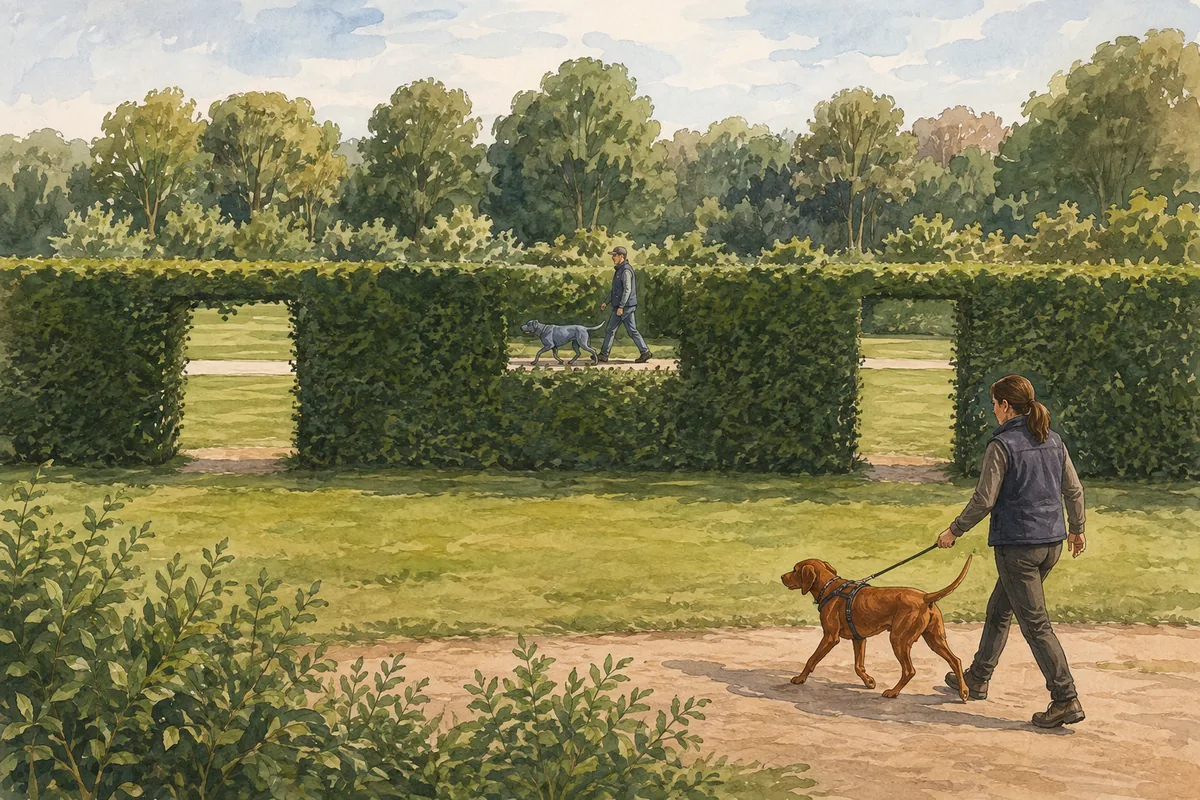
No progress holds if the walk can go wrong while you are learning.
- The equipment that protects without adding constraint
- The way of holding the lead that leaves the dog room to choose
- The rules for going out until the work is in place
Part 2: reading the tipping point
The only instant where you still have a hold, and how to recognise it in your dog.
- The signals that come before the reaction, one by one
- Building your own scale, not a book's
- Deciding in advance what you will do at each level
Part 3: setting up the escape routes with no dog in sight
What has to be automatic on the day the situation tightens.
- The clean turn, rehearsed calmly
- The call that works while moving
- The wide detour, with no jerk
Part 4: changing what a dog's presence announces
The heart of the work, and the part most people skip.
- Why distance conditions everything else
- The exact timing of the association
- The mistakes that reverse the intended effect
Part 5: organising real passing exercises
Moving from encounters you put up with to encounters you prepare.
- Setting up an exercise with a single variable changed
- Passing in parallel before passing head-on
- Knowing when to raise the level, and when to step back
Parts 6 to 9: real life, consolidation and worked cases
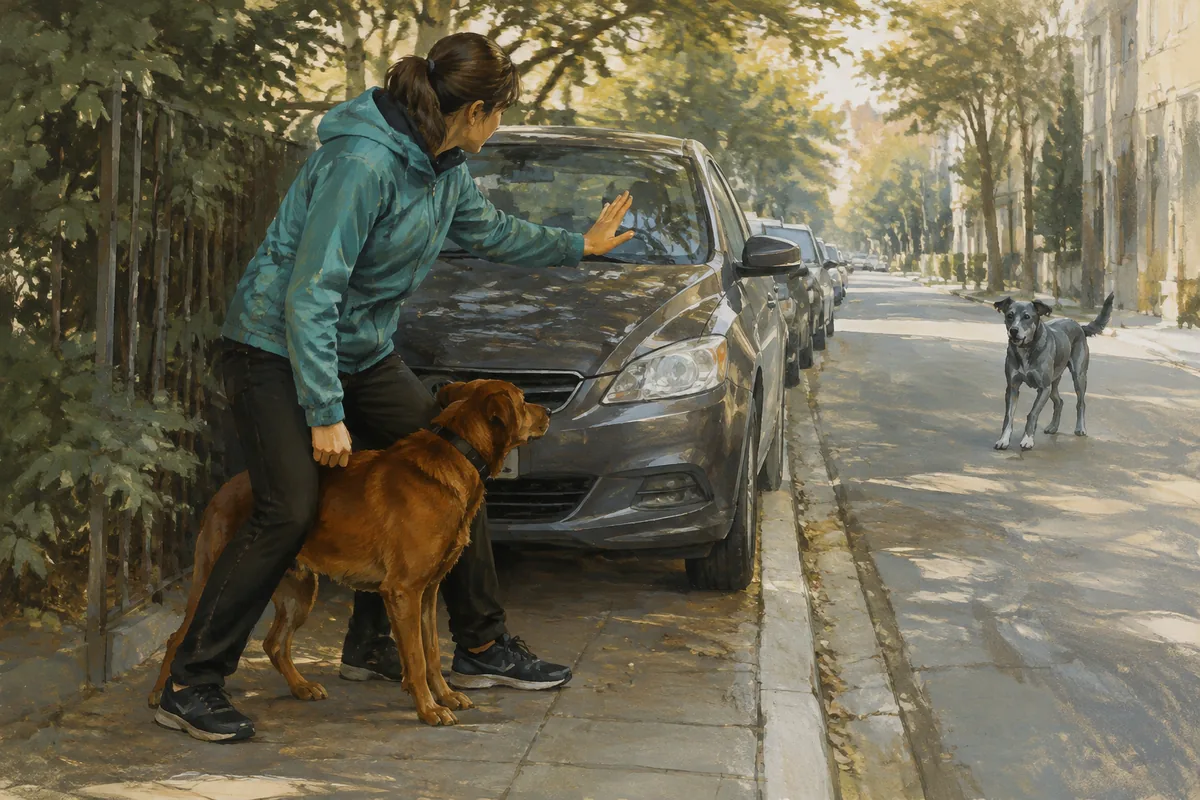
What happens when nothing goes to plan.
- The loose dog that appears, and the recovery afterwards
- The 6-week plan to adapt to your own neighbourhood
- 6 worked cases: which variable to change first
Here is where the book takes you
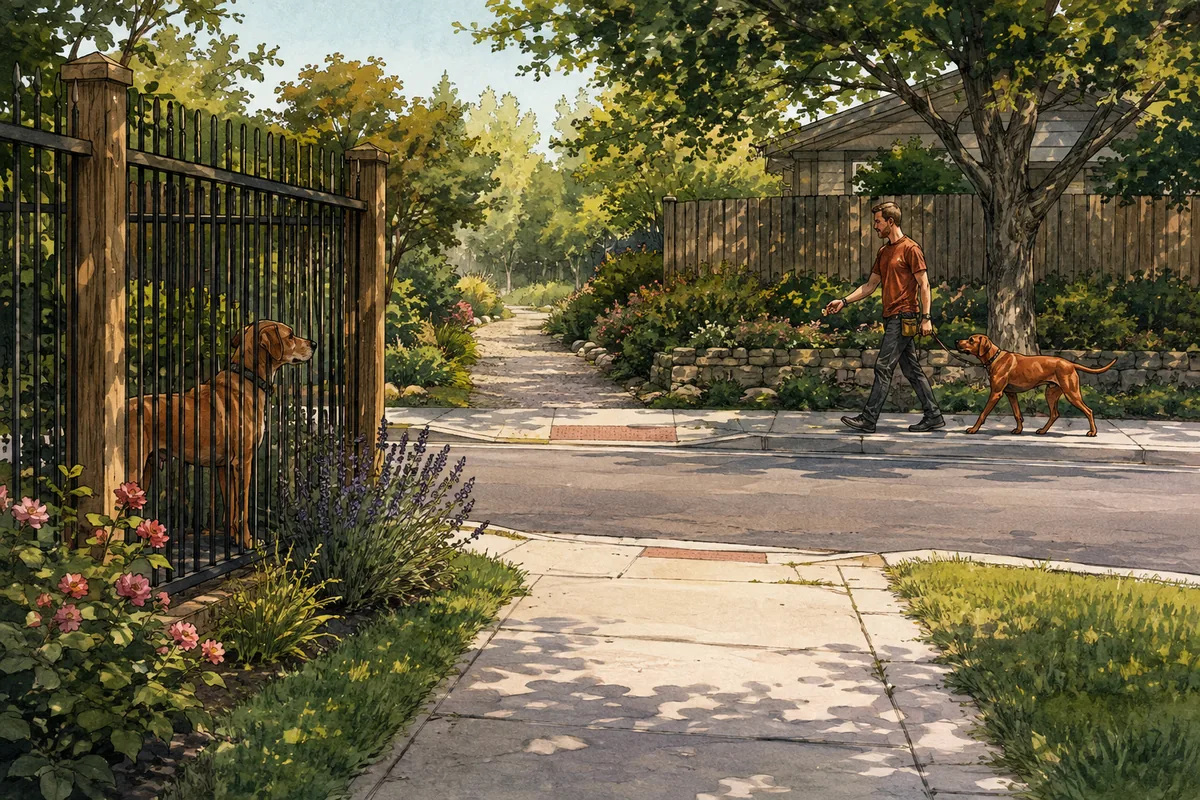
The 6-week calendar: what is worked, and when.
After the 6 weeks, you should not have a dog who is indifferent to other dogs. You should have 4 things:
- A known working distance, measured, that shrinks week after week.
- A clean turn that works on the day you need it.
- Walks at normal hours, in your own neighbourhood, without checking the window first.
- A written course of action for the dog that appears, instead of improvising.
From there, the walk becomes a walk again, and not a surveillance operation.
Here is exactly what you receive
A PDF with 36 illustrations drawn for this book, readable on phone, tablet and computer, and printable if you prefer paper in your hand.
And
The 6-week plan and the walk sheets are printable, to keep in your pocket during the walks.
The download arrives by email a few minutes after payment, with a private link. No parcel, no waiting for delivery.
Here is everything you get today
- The complete digital book "Teach Your Dog to Pass Other Dogs Calmly", nine illustrated parts(value $47)
- The progression plan over 6 weeks, to adapt to your neighbourhood and your dog(included)
- The printable walk sheets: working distance, signals observed, decision taken(included)
- The 6 worked cases, to pick the right variable when things stall(included)
- The printable appendices, to keep in your pocket during the walks(included)
- Total value$86
The price shown on this page is the price charged at checkout. This is a one-off purchase, with no subscription. The product is digital and delivered by email once payment is confirmed.
A 100% digital book to download. Nothing is shipped.
Secure payment by card or PayPal · 30-day guarantee
Our 30-day satisfaction guarantee
Read the book, apply the plan. If you feel it has not helped you, write to us within 30 days at contact@thepupmethod.com and we will tell you straight away how to get your refund.
You do not have to justify yourself. A guide that is of no use should not be paid for.
P.S. Every passing that goes wrong reinforces what you want to see disappear, and every passing that goes well builds the opposite. The difference between the 2 almost always comes down to a few metres of distance decided in advance.
P.P.S. This book does not replace a veterinarian or a dog trainer when a situation calls for one. It tells you clearly when it is better to ask for help.
Secure payment by card or PayPal · 30-day guarantee