How to get a recall that holds when there is something better going on, without chasing after your dog.
A recall is not tested, it is built. This book builds recall reliability step by step, from very close range up to real distractions, before it ever talks about freedom.
Keep reading if you want to:
- Understand why your dog comes back at home and stops coming back at the park, without mistaking it for stubbornness or defiance.
- Build a return reflex at close range, where success is still easy and frequent.
- Get voluntary returns, the ones the dog chooses, not only the reluctant ones you have to coax out of him.
- Work on the long line to progress safely, without gambling on freedom before the facts have earned it.
- Build your own ladder of distractions, from the easiest to the hardest, specific to your dog.
- Keep an emergency recall in reserve, trained separately and never used casually.
From: Léa Fontaine
The Pup Method, a step-by-step educational approach built on observation, repetition and positive reinforcement.
Dear human who has already shouted a name across a park,
He comes back in the living room. He comes back in the garden. Then you let the long line go at the park, another dog walks past, and the name you shout 3 times weighs nothing against what is happening in front of him.
There is no shortage of advice at that point:
- "Only call him when you are sure he will come." The advice is right, but incomplete: it never says how to manufacture that certainty. With no progression, you are simply waiting for luck to be on your side.
- "Hide, he will be afraid of losing you." That can work once. Building a recall on worry means building on something you do not control and that wears out fast.
- "Tell him off when he finally comes back." This is the most expensive mistake of all. What a dog remembers is what happens the moment he arrives next to you. Telling him off then makes the next return slower.
So the recall becomes a bet. Some days it works, some days it does not, and you cannot say why. Little by little, you stop letting him off the lead at all.
If you recognise yourself, remember this:
The day I shouted a name across a park, for nothing
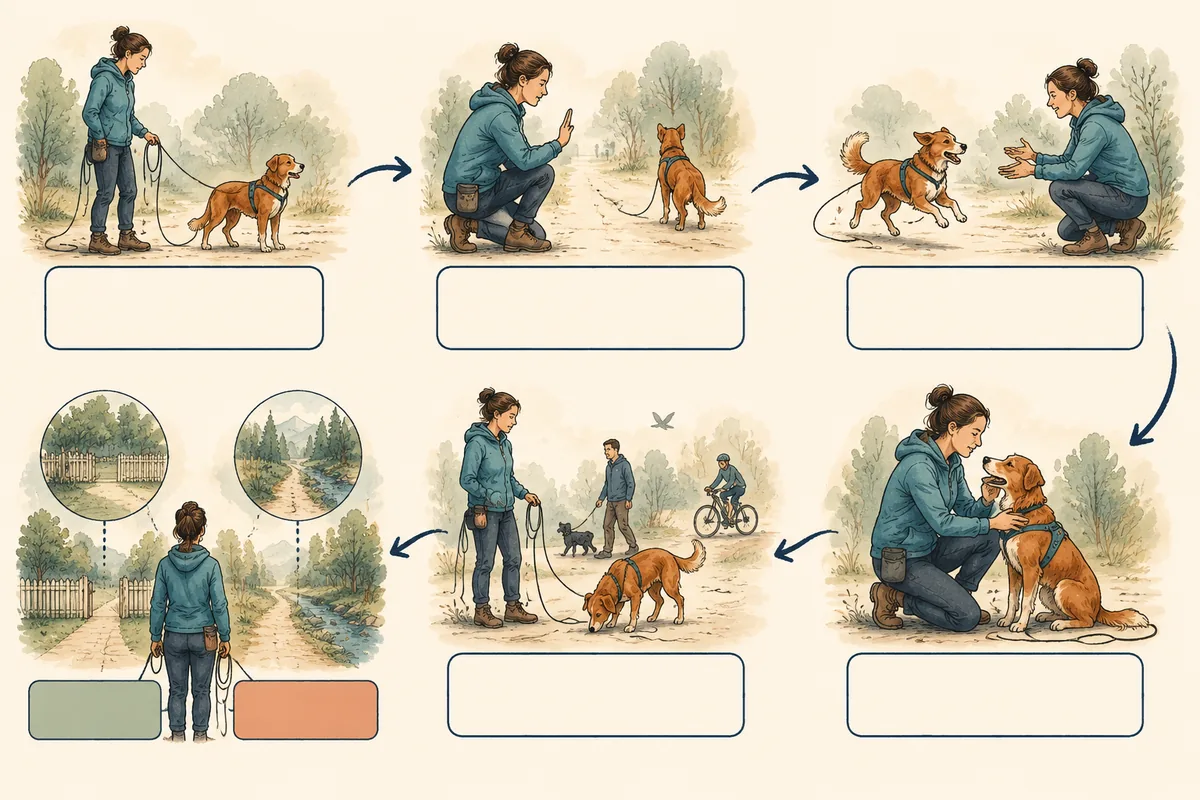
The map of the reliable recall: the stages, in order.
He was 60 metres away, behind a clump of trees, and he was not coming back. I called his name 7 times. On the seventh, I understood that I was no longer calling him: I was wearing the word out.
On the way home, I did the maths. Over the previous 3 months, I had recalled him roughly 200 times. He had come back maybe 120 times. And every single time he came back, the walk ended.
So I had trained exactly the opposite of what I wanted: coming back earned nothing, and not coming back cost nothing.
A recall is not lost all at once. It wears out, call after call, every time you use it without being able to back it up.
This book rebuilds the exact opposite: hundreds of easy successes, then the difficulty, and never the other way round.
The problem is not the word you use
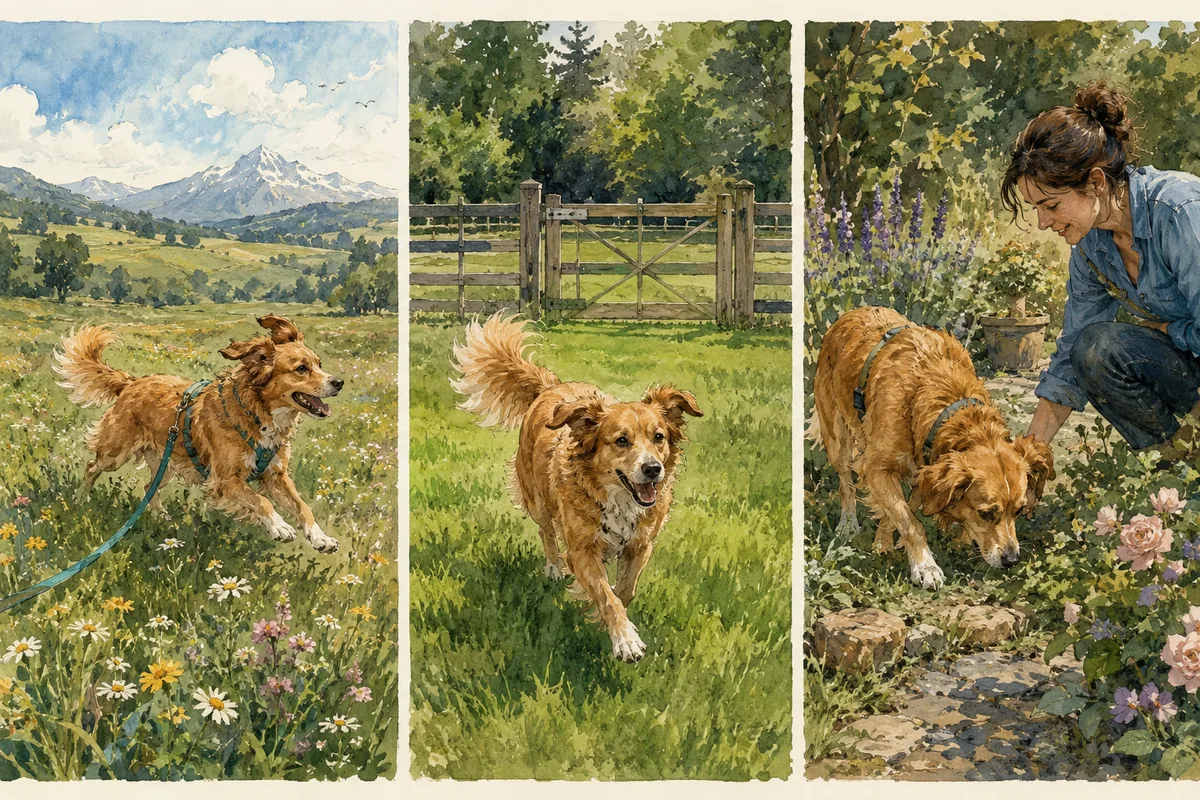
Loading the signal: hundreds of easy successes before any difficulty.
Your dog knows the word. What he does not know is what coming back earns him when there is a rabbit, a smell or another dog in front of him.
Every time he does not come back and nothing happens, the word loses a little of its value. Every time he does come back and the walk stops immediately, coming back becomes a little less appealing.
So a recall is built in 2 directions: what the dog gains by coming back, and what he does not lose by coming back.
A worn-out recall is rarely repaired by insisting. It is repaired by going back to a distance where your dog still succeeds, and rebuilding from there.
At this stage, you have 2 options
The second option is slower over the first 2 weeks and much faster over the following 6, because it does not keep feeding the failures.
The 6 stages of the recall
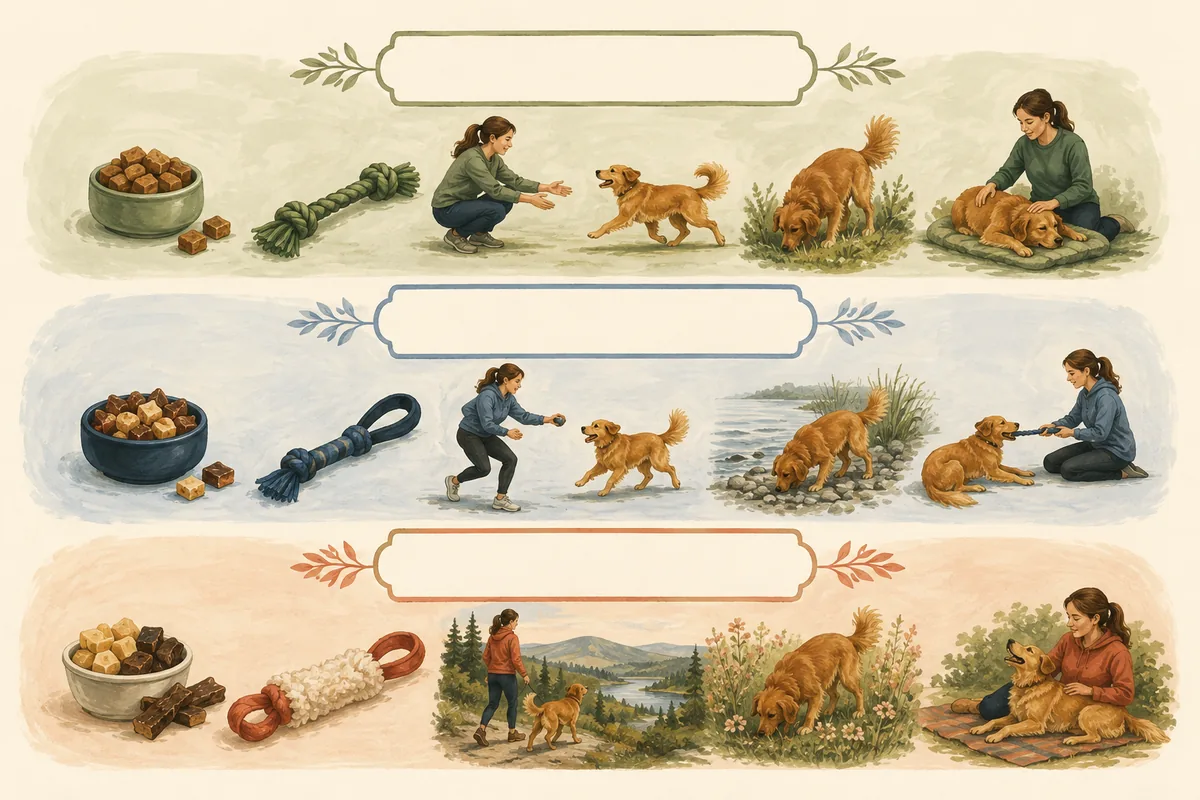
The long-line turn: gaining distance without losing control.
The book builds the return like a staircase. Each stage is validated before you climb to the next one.
- Making the training safe. Long line, place, equipment: no session should ever be able to end in an escape or a danger.
- Creating the reflex at very close range. At 2 metres, a hundred times, until the return becomes automatic and happy.
- Getting voluntary returns. The ones the dog offers by himself, which are worth more than the ones you ask for.
- Working with the long line. Gaining distance without ever losing control of the situation.
- Climbing the ladder of distractions. Your own list, from the easiest to the hardest, crossed in order.
- Reserving the emergency recall. A separate signal, trained on its own, kept for genuine emergencies.
A whole part deals with the question everybody asks: at what moment do you decide to let him off, and on which observable criteria.
Just imagine for a moment...
- Calling once and seeing your dog turn towards you before you have even finished the word.
- Letting him off in a suitable place because the facts tell you to, not because you are crossing your fingers.
- Knowing exactly which stage you are on, and which one to work on this week.
- Having an emergency signal your dog answers, because it has never been used for nothing.
- Stopping yourself from calling 10 times in a row, knowing the tenth is worth nothing.
"Will it work for me?"
My dog never comes back at the park. Then the park is not where you start. The book picks things up at 2 metres, in the hallway, and climbs the ladder in order.
He is a hunting breed, I was told it was hopeless. The breed changes the difficulty and the time, not the method. The book covers dogs with a strong chase drive, in particular on the long line.
I am afraid to let him off. You do not let him off before part 7, and only on observable criteria. The long line does all the work in between.
How long before I see a result? The close-range reflex often settles in 1 to 2 weeks. Reliability outdoors takes the 6 weeks of the programme.
The good news: most of the work is done with no risk
The first stages are worked at home, in a hallway, a garden or a quiet room, a few metres away. The long line comes next, and freedom later still.
- You do not need to let him off to make progress.
- You do not need a fenced field on day one.
- You do not need to shout louder than a distraction.
What you need is easy repetitions, a good moment to reward, and a ladder you climb in order.
I am pleased to introduce the digital book:

Get a Reliable Recall Despite the Distractions: build a solid return before you give your dog his freedom back.
This book is a programme, not a collection of tips. Every stage gives the success criterion that allows you to move to the next one, and what to do when that criterion is not met.
It is organised into 7 progressive parts, with a practical programme over 6 weeks and worked cases from real life. This is a digital book to download, not a paper book shipped to your door.
Here is a preview of what you are going to learn
6 blocks that link understanding, protocol and transfer into real life.
Part 1: making the training safe
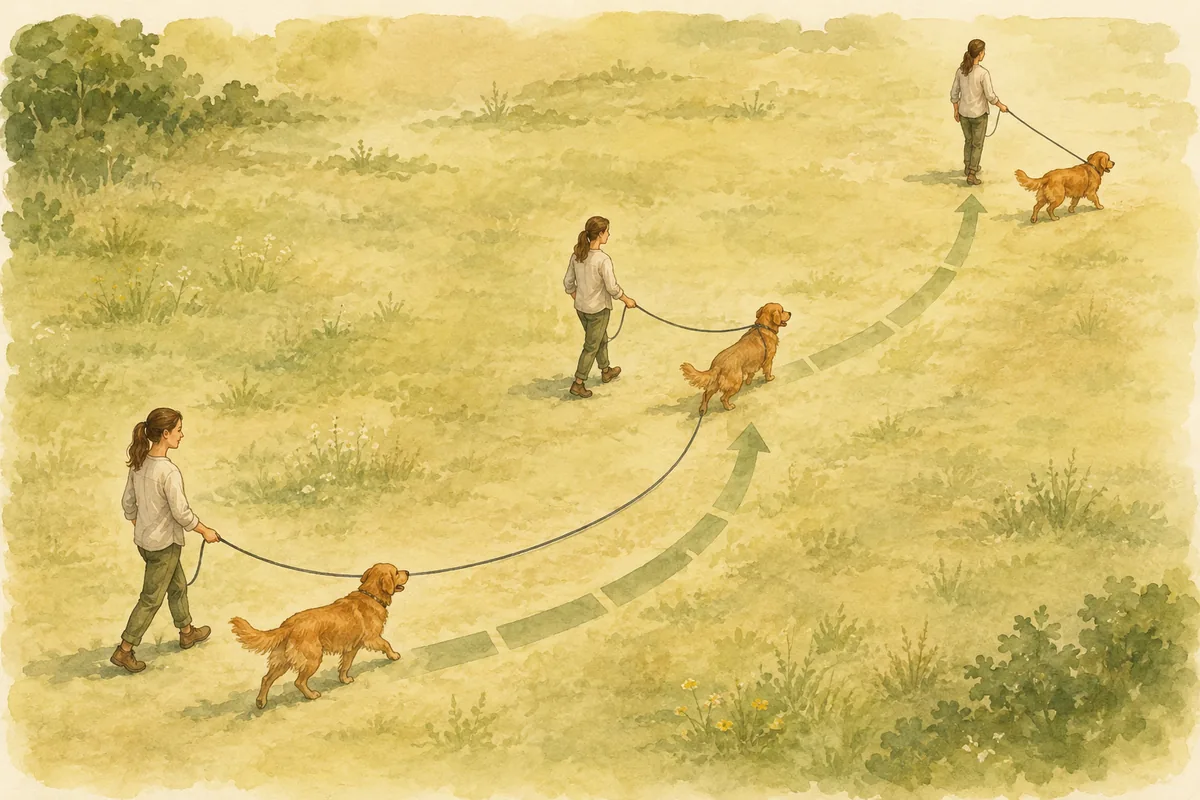
No recall session should ever be able to end badly.
- Choosing the place and the long line
- What you must never do while training
- The mistakes that damage the recall word for good
Part 2: creating the reflex at close range
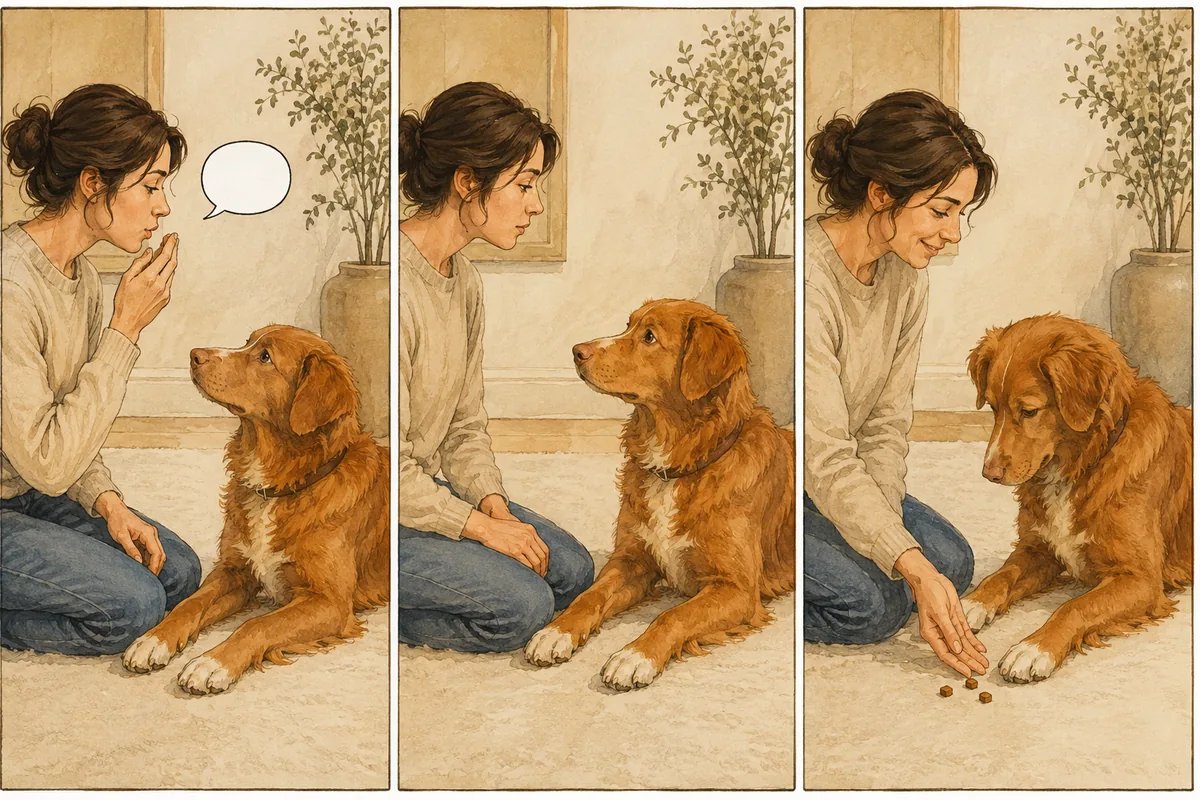
Hundreds of easy successes, before any difficulty.
- The 2-metre protocol
- The timing and the value of the reward
- How to know the stage is solid
Part 3: getting voluntary returns
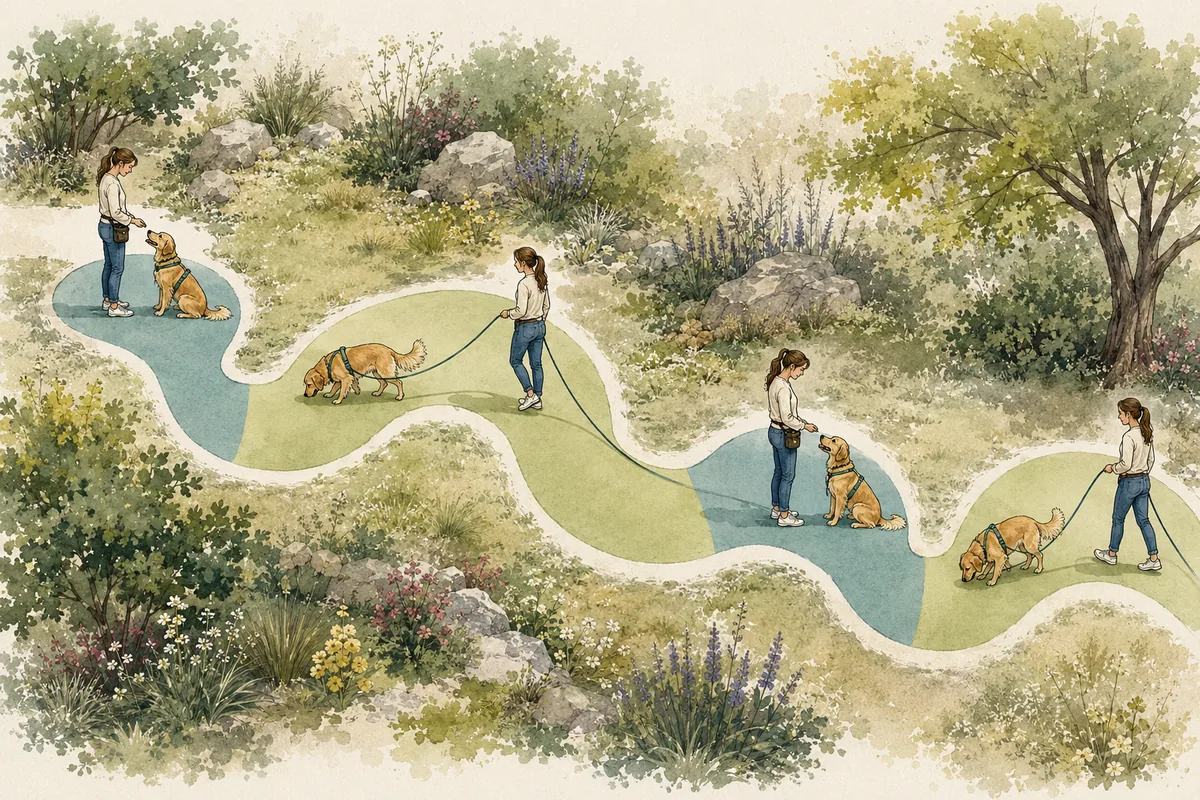
The returns a dog offers are worth more than the ones you ask for.
- Catching and paying for spontaneous returns
- Making the return pay better than the rest of the walk
- Never making a dog pay for coming back
Part 4: working with the long line
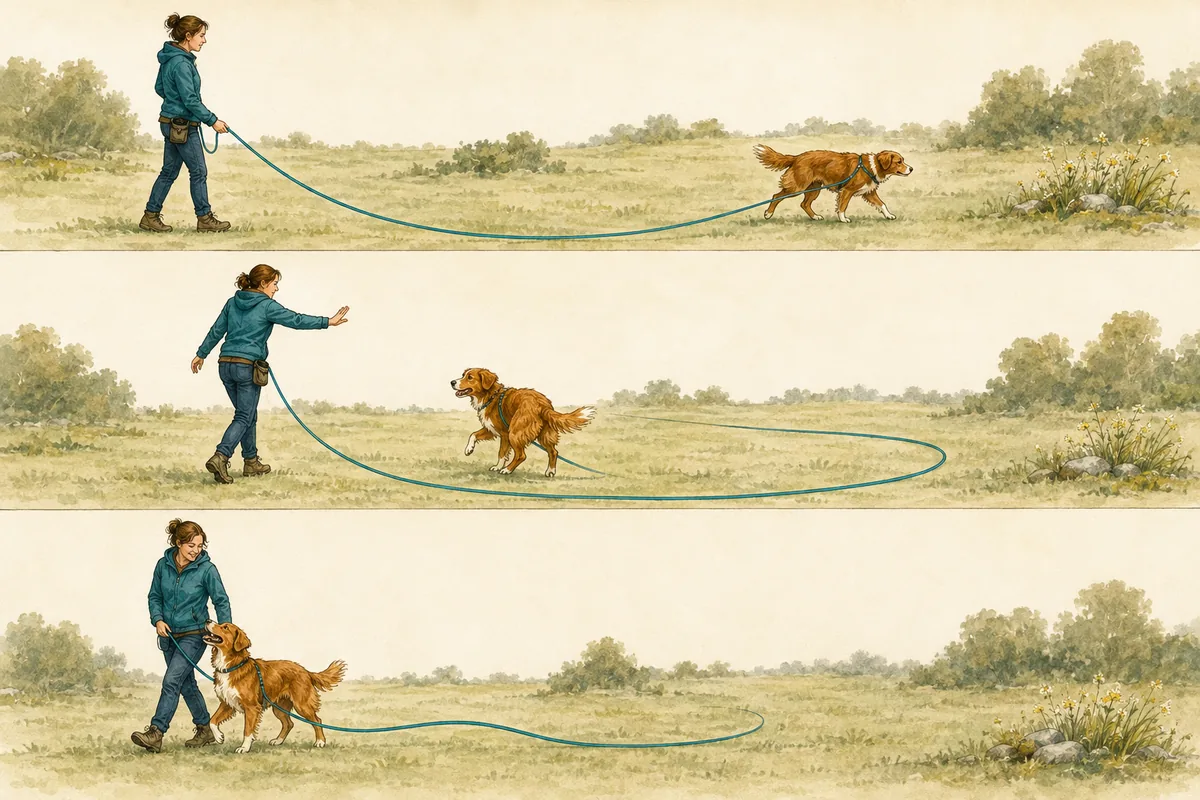
Gaining distance without losing control of the situation.
- Handling the long line without jerks
- Increasing the distance in measured steps
- What to do when there is no answer
Part 5: building the ladder of distractions
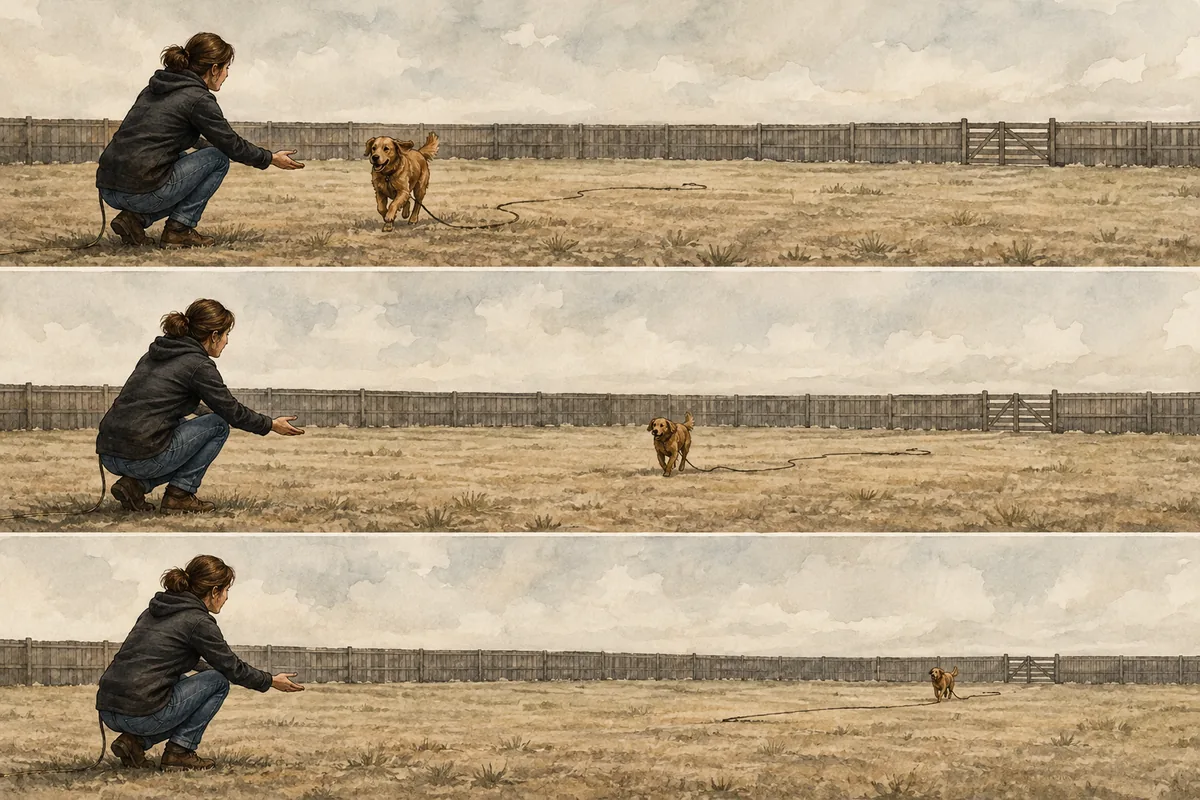
Your list, your dog's list, in order.
- Ranking distractions from the easiest to the hardest
- Only climbing after several clear successes
- Deliberately going back down after a failure
Parts 6 and 7: emergency recall and the freedom decision
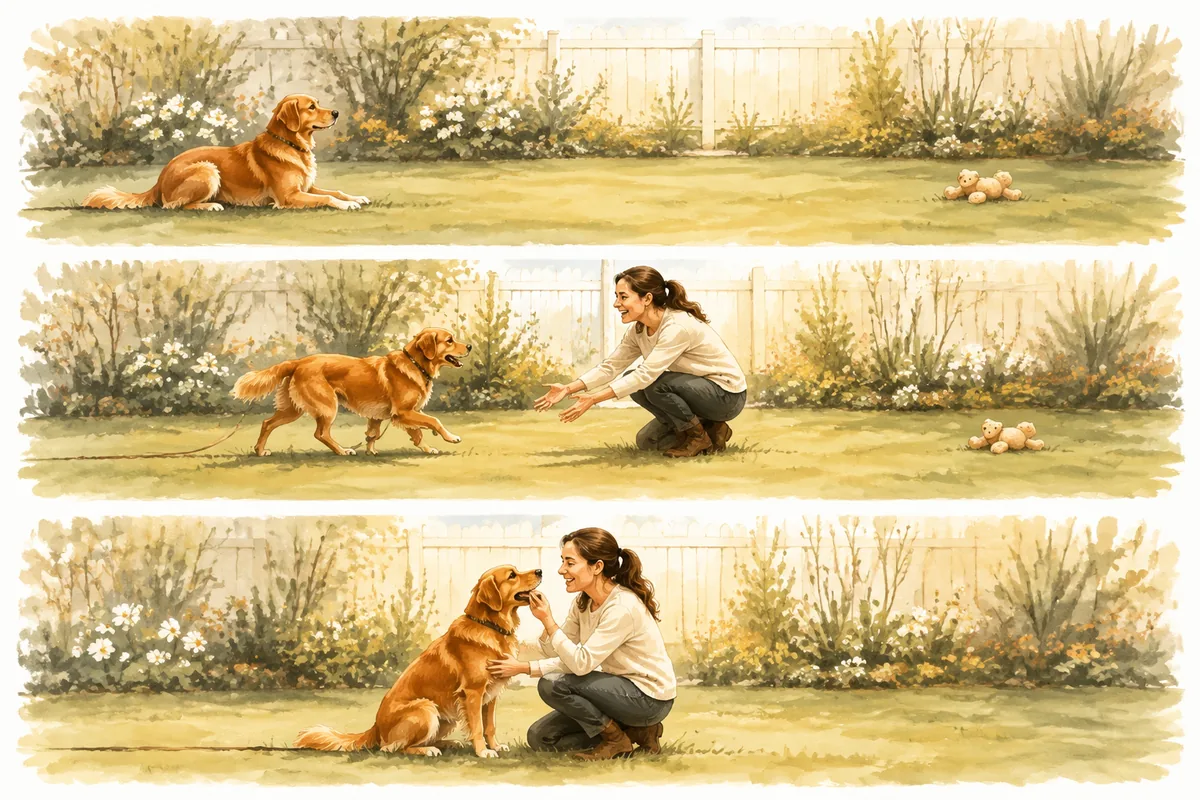
The backup signal, and the moment you genuinely let him off.
- Training a separate emergency signal
- The observable criteria that allow freedom
- The practical programme over 6 weeks
Here is where the book takes you
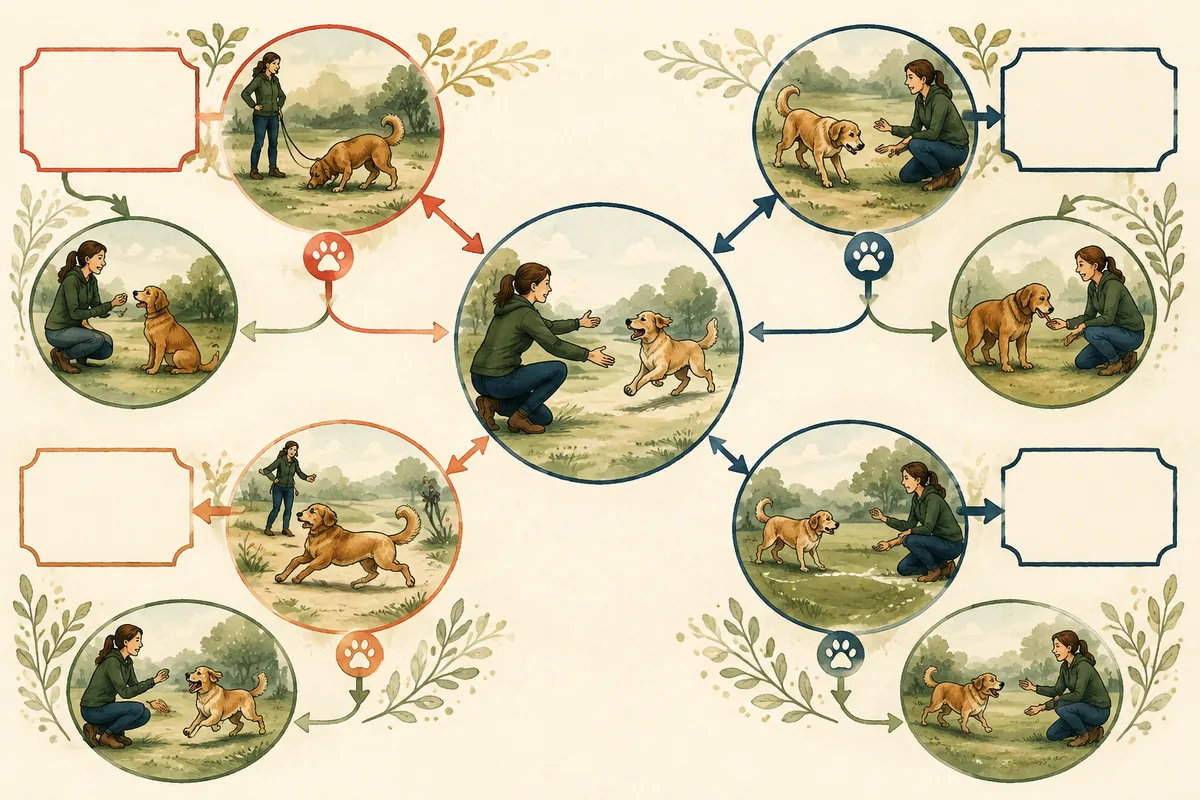
The ladder of distractions, your dog's own, not a book's.
After the 6 weeks, here are the 4 markers the book has you check:
- A dog who turns towards you before you have even finished the word, at close range.
- Voluntary returns, offered by the dog, several times per walk.
- A written ladder of distractions, with the exact level you are on.
- An emergency signal kept in reserve, never used casually.
The decision to let him off becomes a decision based on facts, not a bet.
Here is exactly what you receive
A PDF with 28 illustrations drawn for this book, readable on phone, tablet and computer, and printable if you prefer paper in your hand.
And
The 6-week programme and the distraction grid are printable, so you can record the successes instead of estimating them from memory.
The download arrives by email a few minutes after payment, with a private link. No parcel, no waiting for delivery.
Here is everything you get today
- The complete digital book "Get a Reliable Recall Despite the Distractions", 7 illustrated parts(value $47)
- The practical programme over 6 weeks, stage by stage(included)
- The distraction grid, to fill in for your dog and your environment(included)
- The worked cases from real life, with the decision to make each time(included)
- The printable appendices, to track successes rather than impressions(included)
- Total value$86
The price shown on this page is the price charged at checkout. This is a one-off purchase, with no subscription. The product is digital and delivered by email once payment is confirmed.
A 100% digital book to download. Nothing is shipped.
Secure payment by card or PayPal · 30-day guarantee
Our 30-day satisfaction guarantee
Read the book, apply the plan. If you feel it has not helped you, write to us within 30 days at contact@thepupmethod.com and we will tell you straight away how to get your refund.
You do not have to justify yourself. A guide that is of no use should not be paid for.
P.S. The recall is the one skill that can, one day, prevent an accident. It is also the one you damage fastest by testing it too early, too often and too far away.
P.P.S. This book does not replace a veterinarian or a dog trainer when a situation calls for one. It tells you clearly when it is better to ask for help.
Secure payment by card or PayPal · 30-day guarantee